
Bridging Reality and Fantasy: Architecture in Surrealist Photography
Written by Sasha Socolow, McGill University
Written by Sophie Hill
Born in the 1920s, the Surrealist art movement sought to evoke the logic of dreams, and with it, a sense of systematic confusion. Surrealism was founded upon exploration of the human psyche and conscience, developing in part as a post-World War I rebellion against social norms and conventions. Photography was a relatively new art form at the time, and provided a means for images to bypass the viewer’s rationality. Surrealist photographers achieved this by blending elements of reality and dreams, distorting what is ordinarily accepted as true, and making full use of the uncanny to conceptualize this photographic warping. The uncanny in Surrealism is marked by an eerie quality that renders the ordinary unnerving and ominous to viewers.[1] Surrealist photographers allow the uncanny to guide their works, creating an unsettling impression by experimenting with landmarks of reality, such as architecture, in ways that feel familiar yet distinctly “off.” Through subtle distortions of the built world, Surrealist photographers disrupt ordinary perception and invite viewers into a dreamlike mode of seeing.
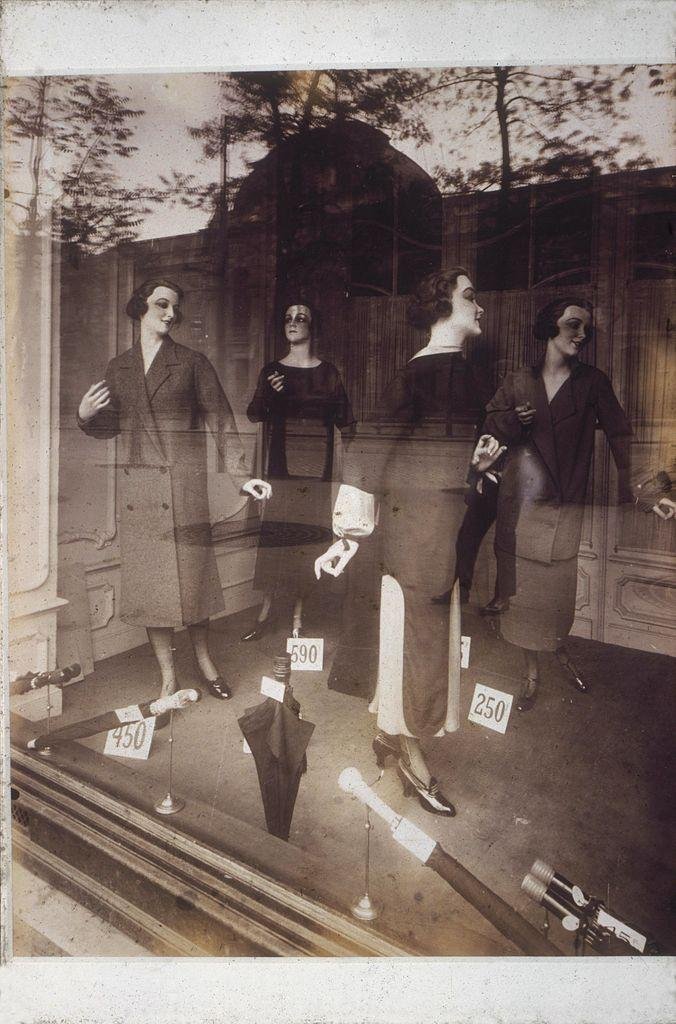
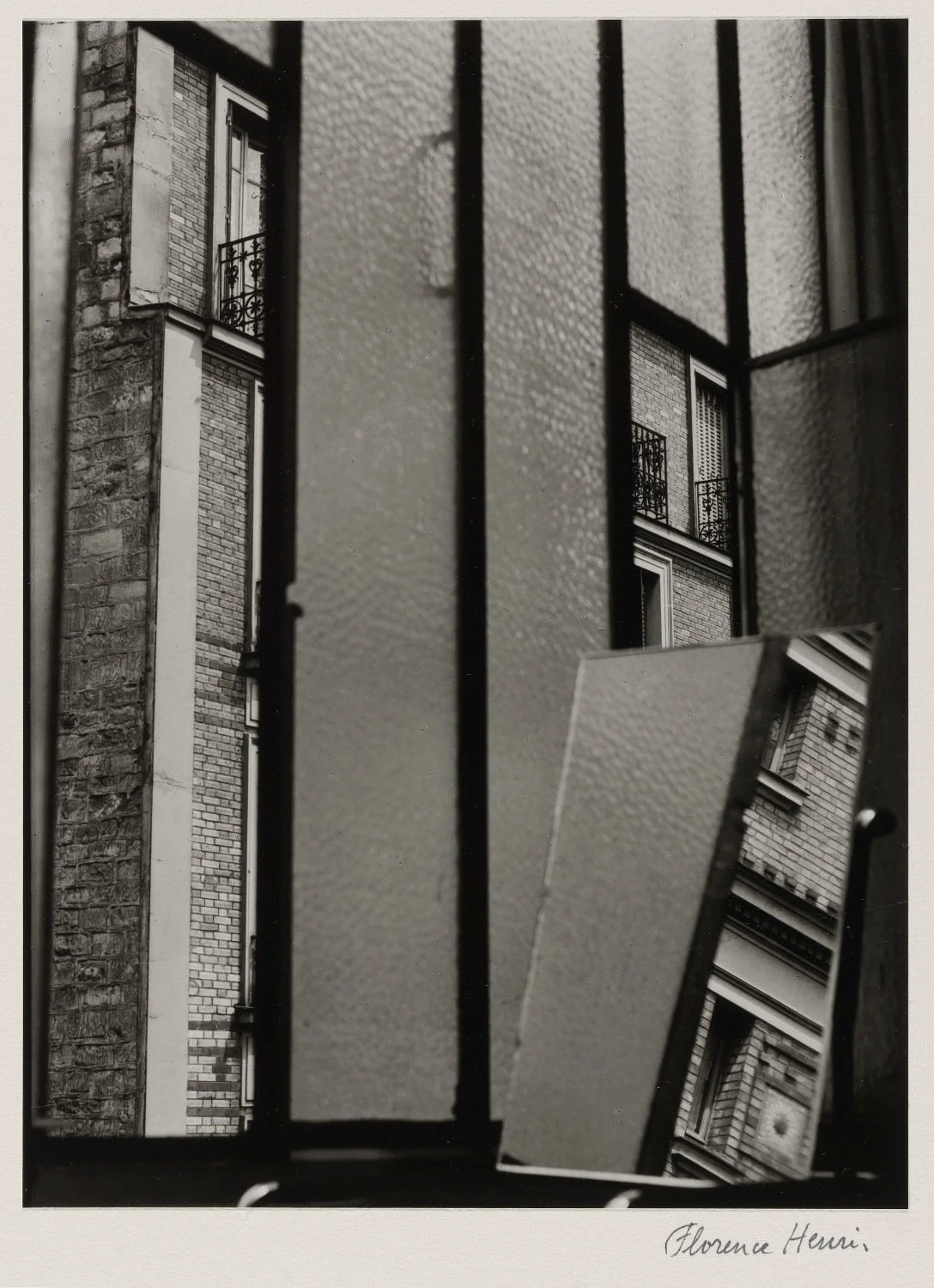
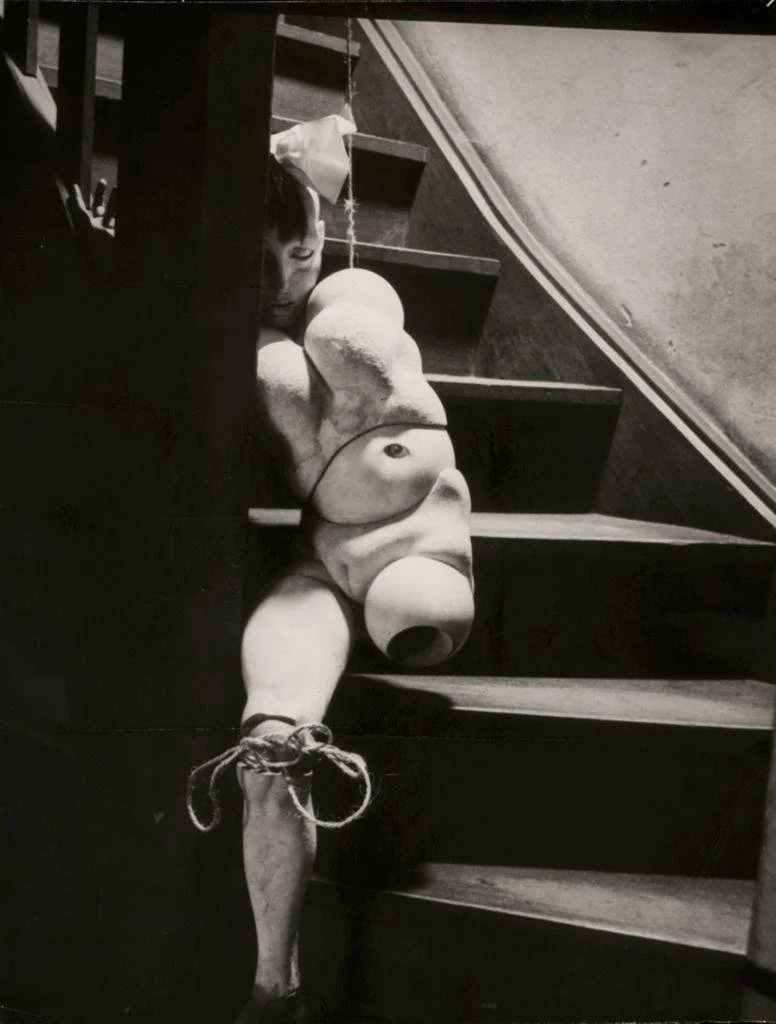
As a foray into redefining relationships with reality, Surrealist photographers experimented with recontextualizing space through architectural elements. Though at first architectural elements can be comfortably identified, closer inspection summons the uncanny by confusing a sense of space, and with it, reality. Eugène Atget, a photographer known for his images of urban landscapes, produced a large body of work that he labeled “documents,” photographs that initially appear to function as straightforward records. Upon closer inspection, however, these images reveal deliberate compositions and carefully constructed contrasts. In Storefront, Avenue des Gobelins, he photographs a storefront display of mannequins, as well as reflections of buildings and trees (fig. 1). These elements are presumably on the other side of the lens, creating multiple yet indistinguishable layers within the photo. Approaching the image logically and isolating the reflection allows the viewer to understand its layers individually. However, when space is allowed to mould around the flattened depth of the storefront’s architectural elements and the reflected building, the image produces confusion and an unsettling sense of eerie queerness. In addition to these recontextualized architectural elements, Atget allows the lifelike mannequins to further mystify the distorted reality and humanity in the series. This manipulation of reflection as a means of spatial distortion is taken further in Parieser Fenster, a photograph by Florence Henri (fig. 2). Originally a Bauhaus photographer, she was also affiliated with Surrealist art and boasts the influence of both in her work.[2] Henri structures the image into a series of panels that alternate between architectural views, blurred panels, and angled mirror reflections of similar forms. The varying angles of the reflection and the direct image are contrasted to further enhance the effect of distorted familiarity. The architectural elements are recognizable, but their compositions unfold with an intentional confusion. While Atget and Henri use architectural reflections to recontextualize space, Hans Bellmer, a surrealist photographer known for creating grotesque life-sized dolls, shifts this strategy by allowing recognizable elements, such as stairs, to blur the boundary between reality and fantasy.[3] In La Poupée, one of these dolls is featured on a fairly unremarkable staircase with one arm draped around the banister (fig. 3). Bellmer provides only enough information to allow the viewer to contextualize the image on what is easily recognized as a staircase. Placing a strange creature in such a familiar domestic structure distorts the reality of a home space. Bellmer urges one to imagine the doll within one’s own living space, forcing the viewer to bring this fictional monstrosity of sadistic representation into their bubble-protected reality. Together, Atget, Henri, and Bellmer exemplify how surrealist artists recontextualize space through the manipulation of familiar architectural forms.
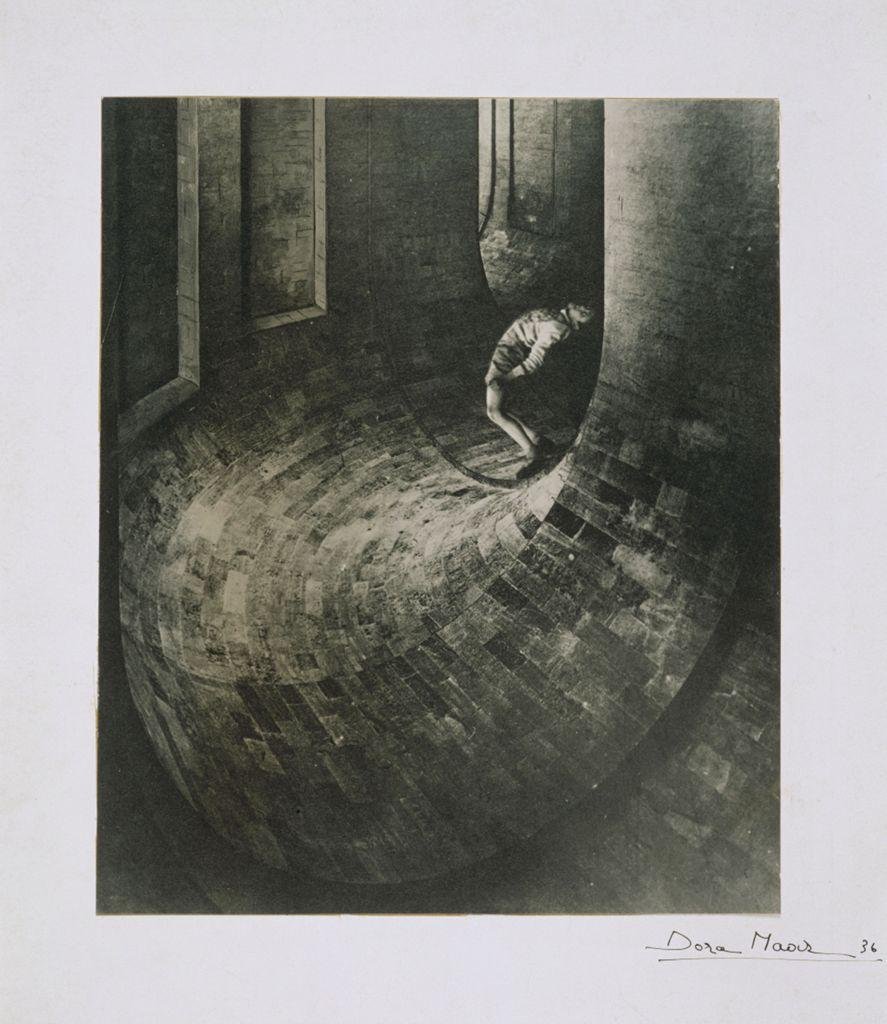
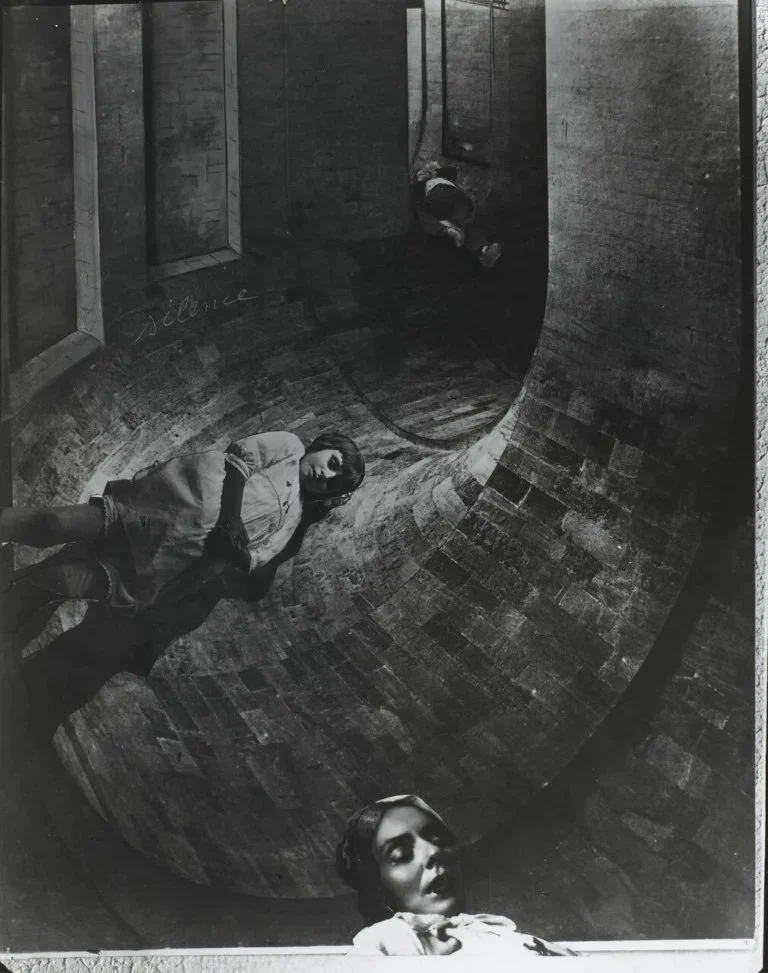
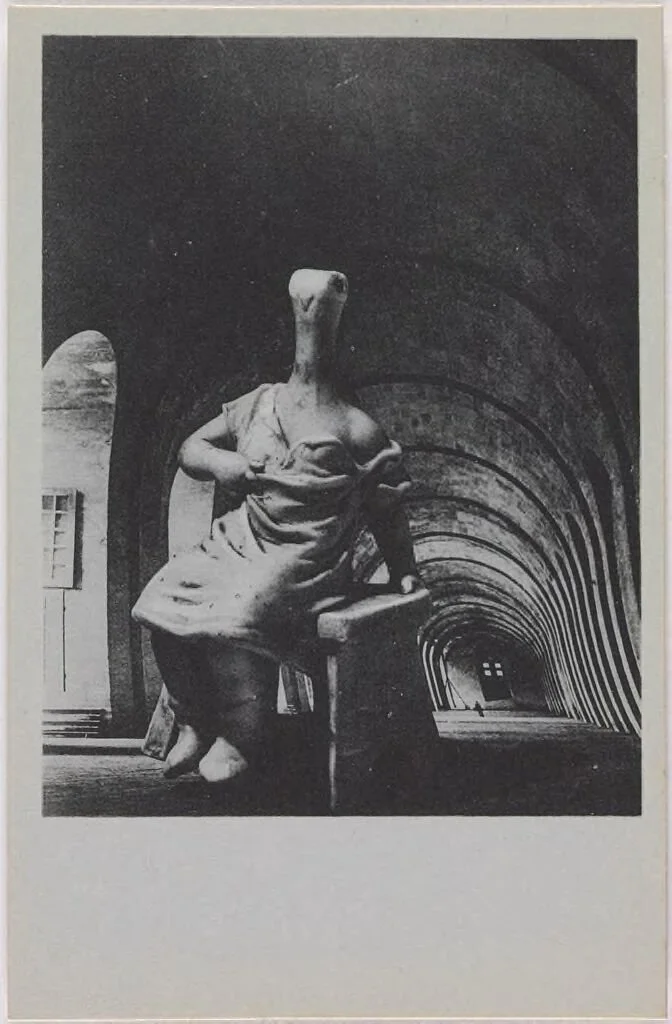
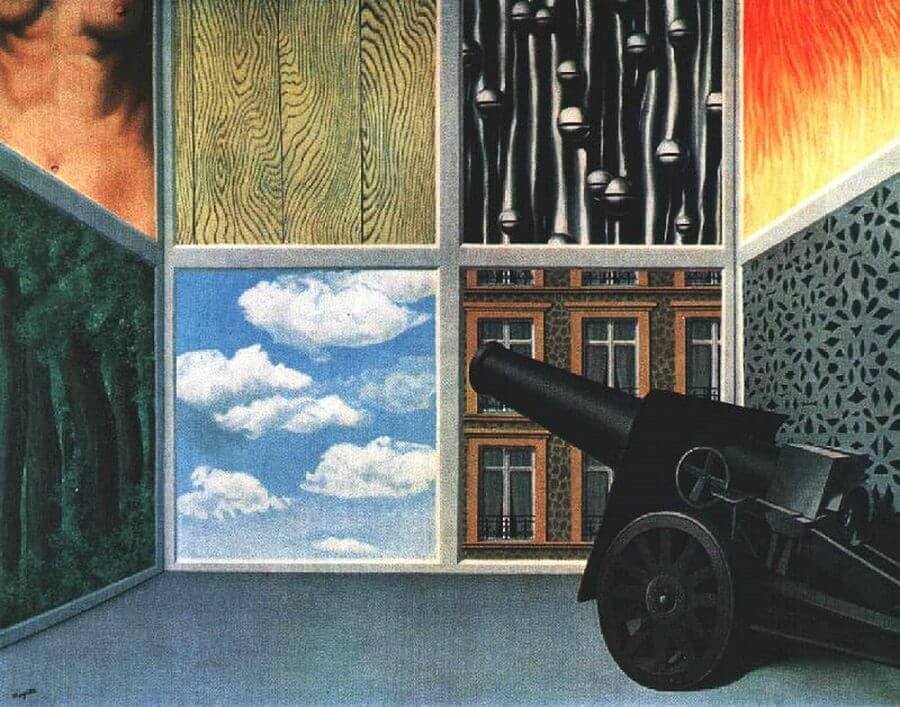
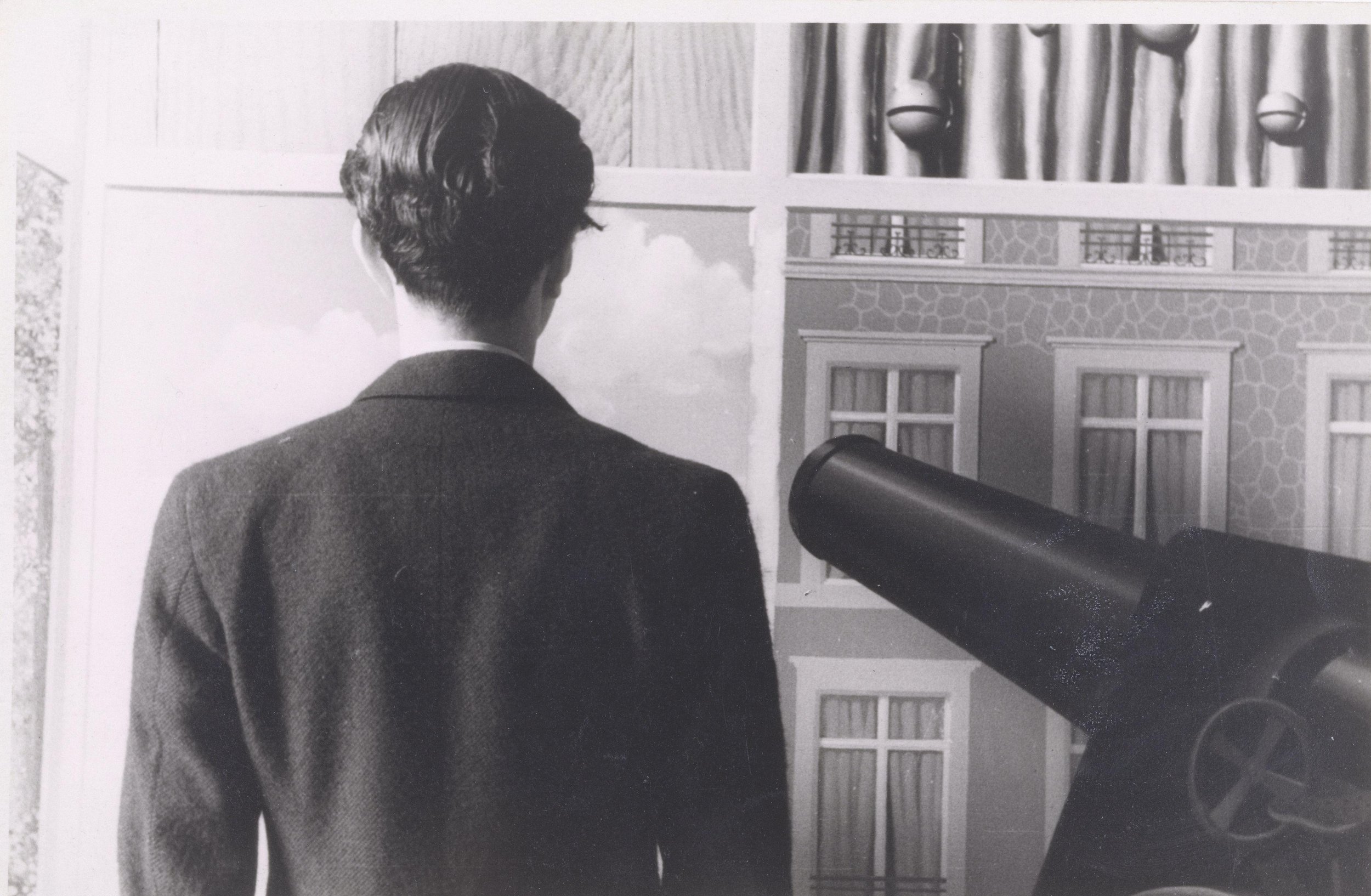
As a medium, photography often bypasses rational scrutiny because it carries an inherent sense of truth for many viewers. Surrealist photographers exploit this assumption by manipulating photographic images to encourage belief in the nonrational. By altering architectural imagery in particular, these artists invoke a pretense of truthfulness in images that are not fully faithful to reality. Dora Maar, a prominent surrealist photographer deeply embedded in surrealist circles, employs distortion techniques to blend reality and fantasy. In Le Simulateur, she uses photomontage techniques to construct an entirely new, fabricated reality (fig. 4). By rotating images of a boy performing a wall flip alongside the Palace of Versailles, Maar engineers a systemic disorientation that harnesses the uncanny to produce a metaphor for history and modern politics. While neither source image is inherently gothic, both carry associations within the French Revolution and child poverty. In the period following far-right riots in Paris, Maar denounced fascism by deliberately manipulating photographs of the Versailles Orangerie, transforming them into the spine-chilling dungeon-like space seen in her work and alluding to the history of the French Revolution. Through this alteration, the images take on an uncanny quality, allowing Maar to draw their latent political implications to the surface.[4] Similar techniques of architectural distortion through photomontage appear in Silence, which reuses the rotated Versailles photograph to reverse gravity, and in 29 rue d’Astorg, which introduces a grotesque creature—reminiscent of Bellmer’s figures—into another corridor of Versailles (fig. 5, 6).[5][6] This surrealist impulse to destabilize reality through visual manipulation also emerges in the work of René Magritte, though through a hybrid engagement with painting and photographic logic. In his painting On the Threshold of Liberty, the composition is divided into window-like panels, each presenting a different pattern or scene (fig. 7). These juxtaposed images resist narrative coherence, while the axillary cannon positioned in front of the panels further intensifies the sense of distortion.[7] The bottom right panel depicts windows, while the top left panel presents the pattern of a wooden floor, confounding spatial orientation. In the meta photograph Edward James in front of “On the Threshold of Liberty,” René Magritte captures the poet and patron standing before the painting after its installation in James’s home (fig. 8). James is positioned with his back turned to the viewer, framed by the painted windows to his right and seemingly threatened by the cannon behind him. By photographing an entirely fabricated pictorial space and allowing it to intersect with the lived presence of Edward James, Magritte constructs a deliberately destabilizing image. This meta layering summons the uncanny by producing a split between architectural representation and reality, leaving the boundary between the two unresolved.[8] The alteration of images has long been a persistent practice across art history, from hand-coloured daguerreotypes enhanced with powdered pigments to contemporary digital manipulation in Photoshop. Surrealist artists are no exception, instead expanding and refining these strategies to achieve the destabilizing effects central to their artistic aims.
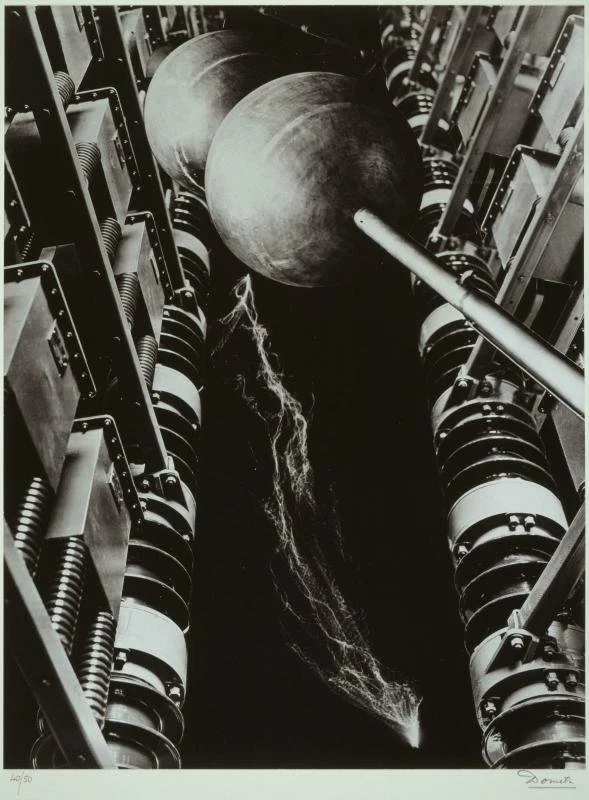
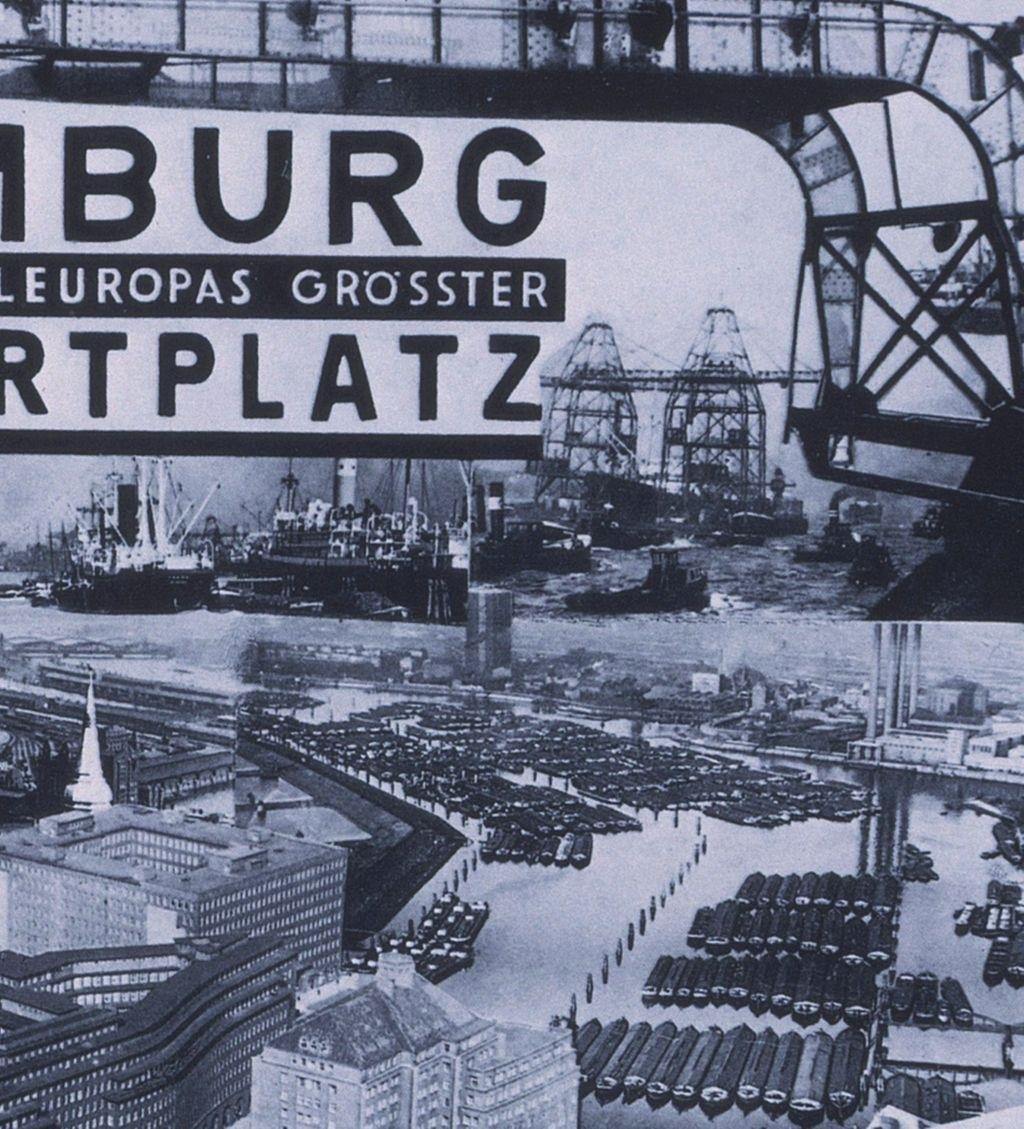
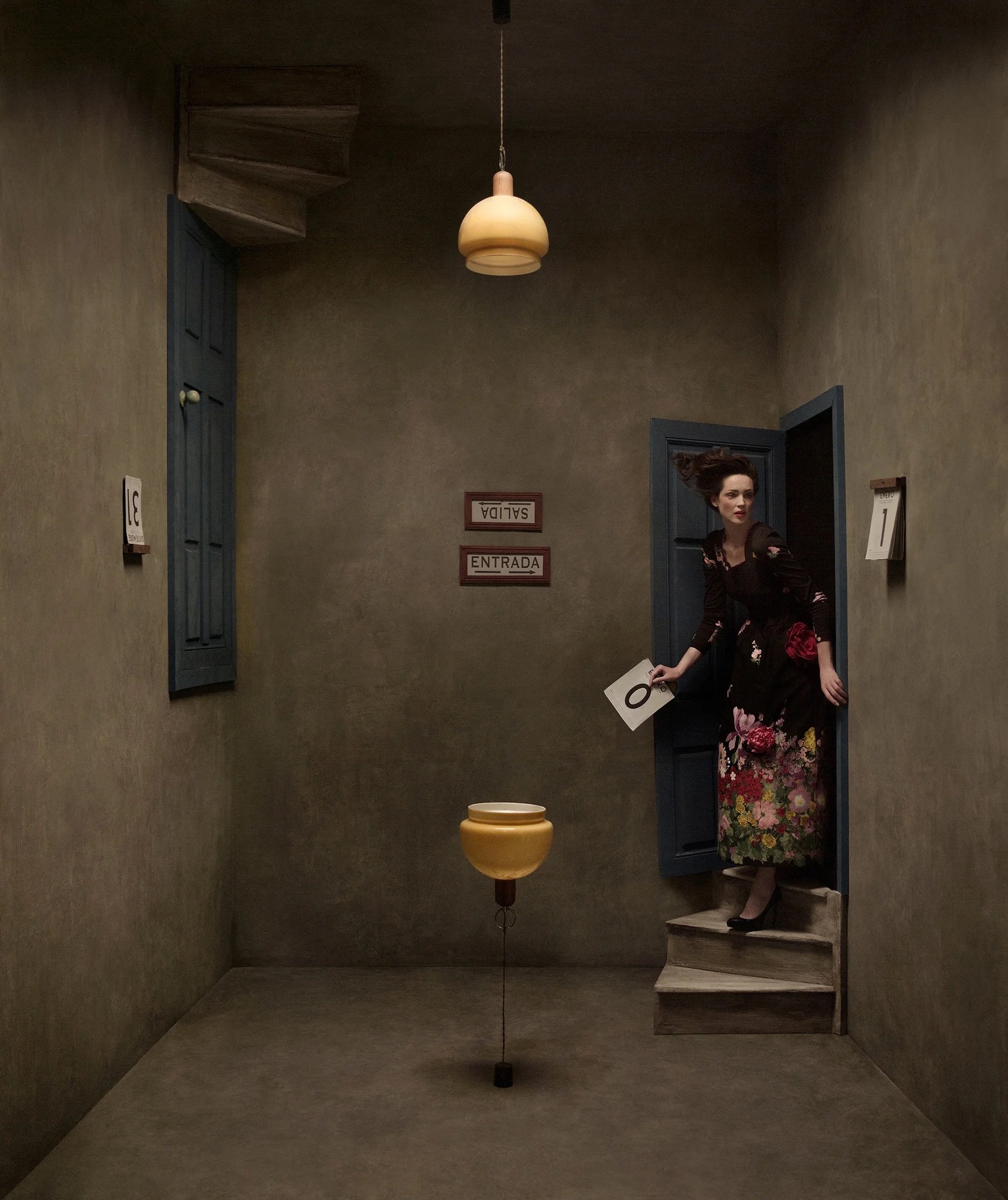
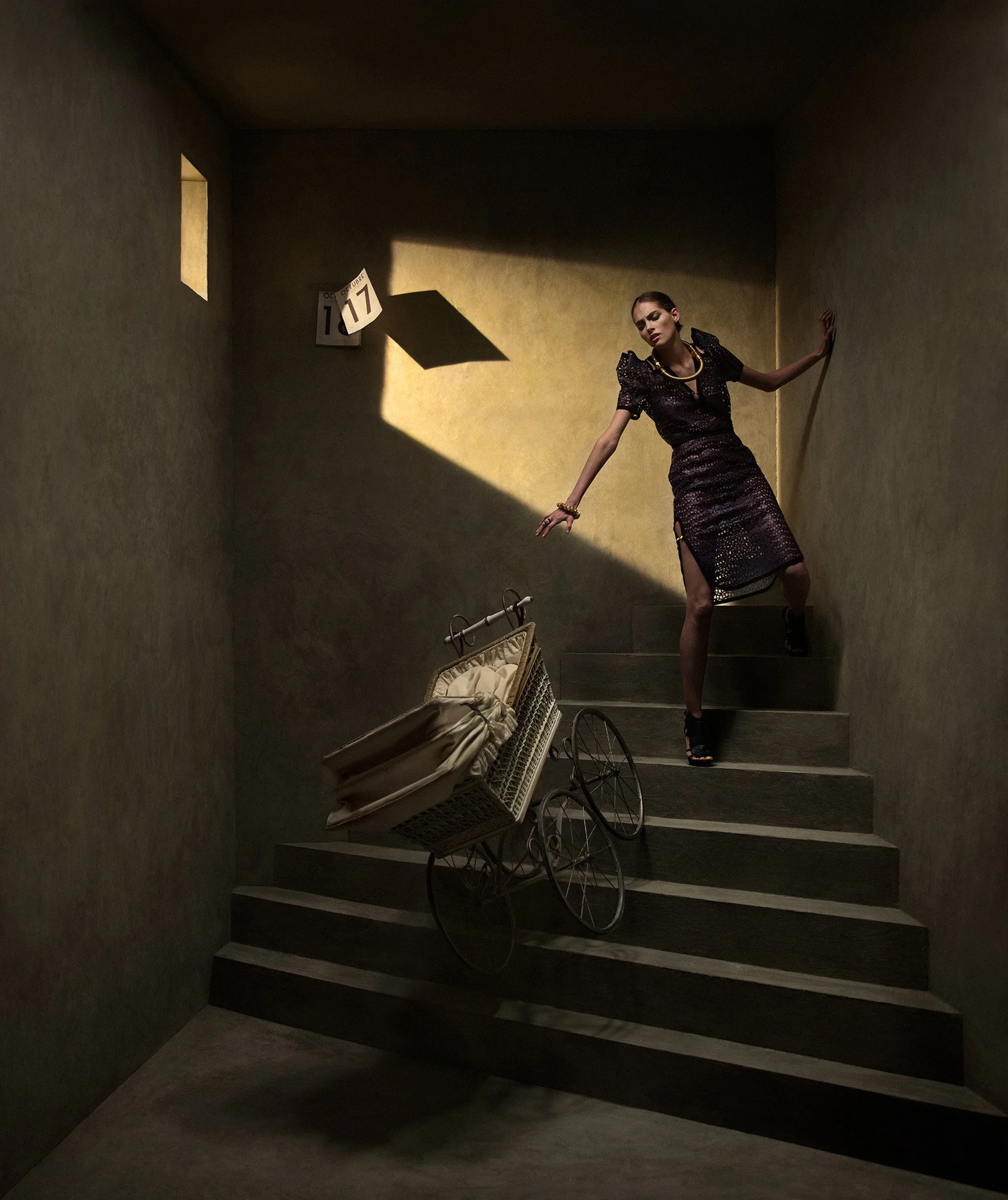
Surrealist photographers heighten the uncanny by re-scaling the real, using architectural forms to overwhelm perception and alter the viewer’s sense of proportion. By invoking a childlike way of seeing in which space appears expansive and exaggerated, they allow familiar environments to drift toward fantasy, generating an effect that feels both estranged and unnatural. Influenced by Cubism and Russian Constructivism, the Surrealist artist Cesar Domela-Nieuwenhuis experimented with architectural scale and proportion to amplify the presence of other subjects within his compositions. In the Energie photomontage, vertical architectural forms frame the piece, while a massive transverse beam dominates the center (fig. 9). At first glance, these framing elements resemble towering industrial structures looming over the scene; on closer inspection, however, they resolve into bolts and metal figures, unsettling the viewer’s sense of scale and spatial logic. While Energie prompts viewers to question the scale and stability of architectural forms, Hamburg, another photomontage by Domela-Nieuwenhuis, is composed largely of recognizable building photographs (fig. 10). These images are compiled and stacked atop one another, creating the illusion of an endlessly expanding cityscape. Whereas Energie distorts reality through the exaggerated scale of a single structure, Hamburg overwhelms perception through sheer accumulation. This effect is intensified by the varied angular perspectives of each photograph, which generate multiple vanishing points and further destabilize the spatial logic of the composition. This visual tradition continues in the work of Eugenio Recuenco, a contemporary Surrealist photographer who constructs unrealistically scaled scenes using architectural elements. Ceilings that soar too high and streets that extend just beyond expected proportions contribute to the uncanny by presenting familiar spaces subtly displaced from reality. In his exhibition 365°, Recuenco produced 365 images, one for each day of the year, that each depict a moment of historical, cultural, or artistic significance.[9] Ranging from the moon landing to the droogs of Clockwork Orange, the series encompasses a wide array of meticulously staged scenes, with post-production alterations used primarily just for color correction.[10] Each scene is set within the same room, defined by dark, worn walls and an unusually high ceiling. Across the 365 images, Recuenco repeatedly reimagines architectural space in ways to accentuate the uncanny. The first image, corresponding to January 1st, depicts two doors on opposite sides of the room, one of which is rotated such that it creates the illusion that half of the scene is inverted (fig. 11). Marking the start of the new year, this composition suggests a 180° inversion of reality. The effect recalls Dora Maar’s photomontages, such as Le Simulateur, in which rotation similarly recontextualizes familiar space and produces new, unsettling meanings (fig. 4). The introduction of domestic elements such as stairs and light fixtures further intensifies the eerie uncanniness by situating familiar architecture within an unfamiliar, constrained context. The scene corresponding to October 17th recreates the iconic baby carriage sequence from Battleship Potemkin, a Soviet propaganda film of immense historical and cinematic significance (fig. 12). Recuenco inserts a staircase into the limited set, transforming the space as he does throughout the series. Angled towards the room and occupying nearly half the height of the set, the stairs work in tandem with the small window and its light to distort spatial perception, collapsing distinctions between scale, reality, and dimension. By manipulating scale and spatial relationships to intensify the real, both historical and contemporary Surrealist artists foreground the fantastical elements latent within everyday space.
Across the vast arsenal of techniques employed by Surrealist artists to evoke the uncanny, architecture emerges as a particularly potent site of manipulation, a concrete anchor of reality that can be altered, distorted, and recontextualized. Through architectural forms, artists heighten perception, destabilize spatial logic, and twist the familiar into fantasy. Whether through reflection, rotation, scale, or montage, Surrealist photographers do not merely record the world but deliberately construct new realities, using architecture as a fundamental framework through which the boundary between reality and fantasy is persistently unsettled.
Endnotes
[1] Royle, Nicholas. The uncanny. Manchester University Press, 2003.
[2] Krauss, Rosalind. "The photographic conditions of surrealism." October 19 (1981): 3-34.
[3] ‘The Doll’, Hans Bellmer, c.1936.” The Tate, January 1, 1970. https://www.tate.org.uk/art/artworks/bellmer-the-doll-t11781.
[4] Taylor, Phil. “Close-up: Deep Fake.” Artforum, December 7, 2023. https://www.artforum.com/features/phil-taylor-on-dora-maars-le-simulateur-1935-246930/.
[5] “Dora Maar 29 Rue d’astorg.” Art Blart. Accessed December 18, 2023. https://artblart.com/tag/dora-maar-29-rue-dastorg/.
[6] Matthew Dennison. “In Focus: Why Dora Maar’s Vision Placed Her in the First Rank of Surrealists.” Country Life, February 14, 2020. https://www.countrylife.co.uk/luxury/art-and-antiques/in-focus-why-%EF%BF%BCdora-maars-vision-placed-her-in-the-first-rank-of-surrealists-%EF%BF%BC-211511.
[7] “On The threshold of liberty, 1937 by René Magritte”. Accessed December 18, 2023. https://www.renemagritte.org/on-the-threshold-of-liberty.jsp.
[8] Freer, Scott. “Magritte: The Uncanny Sublime.” Literature and Theology 27, no. 3 (2012): 330–44. https://doi.org/10.1093/litthe/frs056.
[9] “365° - Eugenio Recuenco.” Eugenio Recuenco - Eugenio Recuenco es un fotógrafo y artista , creador de imágenes que se expresa a través de la fotografía, del cine e igualmente de la escenografía, July 1, 2019. https://eugeniorecuenco.com/portfolio/365-site/.
[10] Scott, Bruce. “Take a tour through the Lightbox exhibition 365° by Eugenio Recuenco”. Accessed December 18, 2023. https://www.prestigeonline.com/th/lifestyle/art-plus-design/365-lightbox-exhibition-by-eugenio-recuenco-at-river-city-bangkok/.