
Written by Holly Kohler, McGill University
Edited by Marie Peck and Sophie Hill
Introduction
Soon after the invention of photography in the early-to-mid nineteenth century, photographers began capturing the nude human figure with the aim of depicting the human body through a modern medium.[1] This new canon of nude photography confronted artists with questions of sexuality, objectification, gender, power and gaze, all queries which still persist today. Dutch queer photographer Erwin Olaf, who recently passed away in 2023, is one such artist who has navigated these questions in the context of the twentieth and twenty-first centuries. In this paper, I will argue that Erwin Olaf’s photographs of the human body reject heterosexual desire and reappropriate the gaze by representing the body as a subject.[2] Specifically, he refuses to represent nudity as male-centric voyeurism or pornography, instead reframing it as both a study of corporeality and a dignified means of looking at the human body.[3] In doing so, Olaf’s works denote a queering of the gaze and a disruption of gender essentialism, thus transforming John Berger’s concept of the nude into the naked.
In what follows, I will first outline Laura Mulvey’s theory of visual pleasure and the heterosexual division of labour with respect to the gaze. I will then explicate John Berger’s thesis about gendered objecthood in art. Next, I will highlight select works by Erwin Olaf and discuss how he challenges Mulvey and Berger’s arguments by transforming nudity from voyeurism and pornography to corporeal appreciation and art. Accordingly, I will explore how Olaf’s photography constitutes a queering of the gaze and a rejection of binary gender representations. Finally, I will examine potential counter perspectives to my argument and consider the broader implications of Olaf’s work.
Theoretical Framework: Laura Mulvey and John Berger
In her 1975 piece Visual Pleasure and Narrative Cinema, Laura Mulvey establishes a theoretical framework to analyze how heterosexual, “socially established interpretation[s]” of gender difference come to the fore in film through a gendered split of the “look” or “gaze.”[4] Specifically, she argues that scopophilia—or voyeurism—regards others as objects through a controlling gaze, with a dichotomy between women as the object or “image” and men as the subject or “bearer of the look.”[5] Mulvey’s arguments extend to photography, particularly nude photographs, in which women are passive objects confronted with the active male gaze. This “voyeuristic-scopophilic” gaze is characterized by a “heterosexual division of labour”: a gendered split between spectacle and narrative.[6] Specifically, women, whose bodies act as a source of pleasure for men, bear the burden or ‘labour’ of erotic spectacle. Men, who gaze at these women, thus control the narrative about them. For Mulvey, this dynamic effectively denies women any possibility of subjecthood.
Mulvey’s theory reflects John Berger’s 1972 work Ways of Seeing.[7] Namely, Berger elaborates a similar active/passive gendered divide by arguing that men “act” and women “appear.”[8] In essence, Berger theorizes the male gaze as an active agent that drives women to turn themselves into an object, either consciously or subconsciously, for men. What emerges is the onlooker viewing women as objects through the male gaze, which renders them what Berger deems a sight.[9] When applying this argument to a photograph of a naked woman, Berger would contend that the woman’s nudity is not for herself or of her own volition. Rather, it is an indication of both submission to and appearance through male feelings and demands. Berger subsequently makes a critical distinction between two often interchangeable terms: nude and naked. To be naked, for Berger, signifies ‘being oneself’; to be nude, on the other hand, is to be seen as naked by others and to be engaged with as an object.[10]
Helmut Newton’s 1980 photograph Self-Portrait with Wife and Models, Paris, Vogue Hommes (Figure 1) embodies both Mulvey’s arguments about the spectacle-narrative gendered divide between men and women and Berger’s assertions about action-appearance. Firstly, the model in this photograph poses according to what we can assume are Newton’s instructions. In Mulveyian terms, not only is this model the ‘image’ that bears the burden of a man’s ‘look,’ but she also configures her body in a way that lacks narrative control. Specifically, Newton holds the camera and makes active decisions about how to portray his model and how she should pose, effectively controlling how we as the viewer see and understand this woman’s body. The holding of the camera thus symbolizes the Mulveyian concept of men as narrators and women as erotic spectacle. The title’s description as a “self-portrait” further indicates that Newton is in control of the story. He is the active agent framing the photograph; his models are mere props to support his composition and narrative.
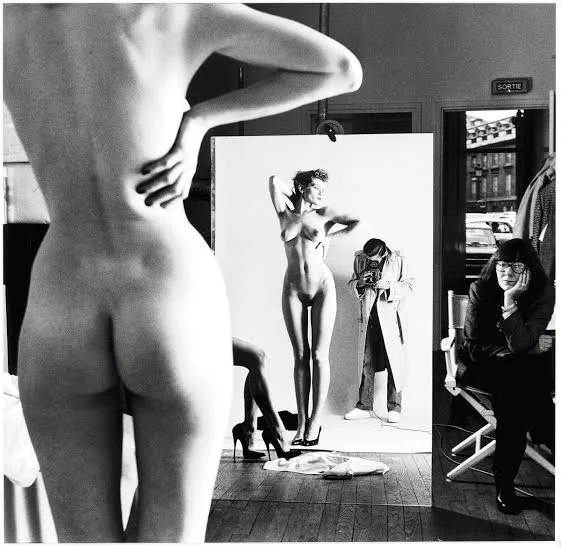
Figure 1: Helmut Newton, Self-Portrait with Wife and Models, Paris, Vogue Hommes, 1980. Online: https://www.artsy.net/artwork/helmut-newton-self-portrait-with-wife-and-models-vogue-studios-paris
An Exploration of Erwin Olaf’s Photography of The Human BodyFrom a Bergerian perspective, the model’s nudity is not of her own accord. Rather, by posing according to Newton’s photographic direction, her nudity submits to the male gaze as a ‘sight’ to be consumed for men’s visual pleasure. Finally, the inclusion of Newton’s wife in this photograph importantly illustrates Berger’s argument that women also look at other women through men’s eyes. The wife sits rather apathetically, observing the scene, but she crucially does so through the control of her husband’s eyes and command. She therefore encompasses a double gaze, existing as both an object of, and onlooker to, her husband and his camera’s gaze. Newton’s photograph is therefore a visual demonstrator of Mulvey and Berger’s theories in practice and is an important point of reference that will frame the following discussion of Olaf’s photographs.
Erwin Olaf, Selected Works: The Body As Subject
Both Mulvey and Berger’s theories discuss representations of the human body as featuring a strong sense of gendered dichotomy between subjecthood and objecthood. Olaf’s photography disrupts this binary both by rejecting normative depictions of heterosexual desire and by reappropriating voyeuristic ‘nudity’ into corporeal ‘nakedness.’ As I will demonstrate, Olaf photographs the naked or semi-naked human body with an honesty and authenticity that reframes the viewer’s gaze from objectification to subjective appreciation.
From Voyeurism to Corporeal Appreciation
For Olaf, photographing the naked human body was not primarily a question of entertainment or pleasure, but rather one of “dignity and visibility in representation.”[11] In other words, Olaf was interested in studying the human body as a physical and emotional entity, and he aimed to learn more about human sexuality and corporeality in the process of capturing the body in his camera. Critically, Olaf rejected the social taboo that surrounds human genitalia and the tendency of art to hide it in order to accommodate what is deemed ‘societally acceptable.’ For him, depicting human genitalia in many of his photographs was a matter of ‘re-discovering’ what is usually a hypersexualized element of the human body. He chose not to hide it because “...[the private part] is just [one] part of the body.”[12]
This pragmatic outlook on the human body heavily informed Olaf’s photography practice, in which he displays the body not as an object of voyeurism, but rather as a fully formed subject appreciated for its corporeality and humanity. Specifically, Olaf was curious about skin, nudity and flesh—everything that contributes to the raw human form.[13] This interest in the corporeality of the naked body creates a decidedly non-voyeuristic effect. Differing from Mulvey’s conception of “watching, in an active controlling sense, an objectified other,”[14] Olaf’s works allow viewers to see the human form as an autonomous subject whose body is more than just its sexuality.
Olaf’s 2015 piece Female Nude 01-03 - Triptych (Figure 2) illustrates the transition from voyeurism to corporeal appreciation. As compared to Newton’s piece (Figure 1), this triptych pictures a woman whose body is overall freer, rawer and less stylized. First, Olaf’s work employs a fuller frame of focus that encaptures a whole view of the woman’s body. While Newton’s photograph equally captures the entirety of the woman’s form, the emphasis on her backside effectively guides the viewer to focus on a singular part of her body that is often hypersexualized, particularly by men. In this way, Newton is the narrator of the woman’s body, telling us what to focus on. Moreover, the gaze of each woman indicates their sense, or lack thereof, of autonomy and subjecthood. In Newton’s photograph, the woman looks away, almost in a knowing way; she knows she is on display for a curious eye. In Olaf’s photographs, however, the woman’s gaze meets the viewer directly in the eye, allowing us to acknowledge her as a subject. Even in the middle photograph, her closed eyes appear to be of her own volition, as
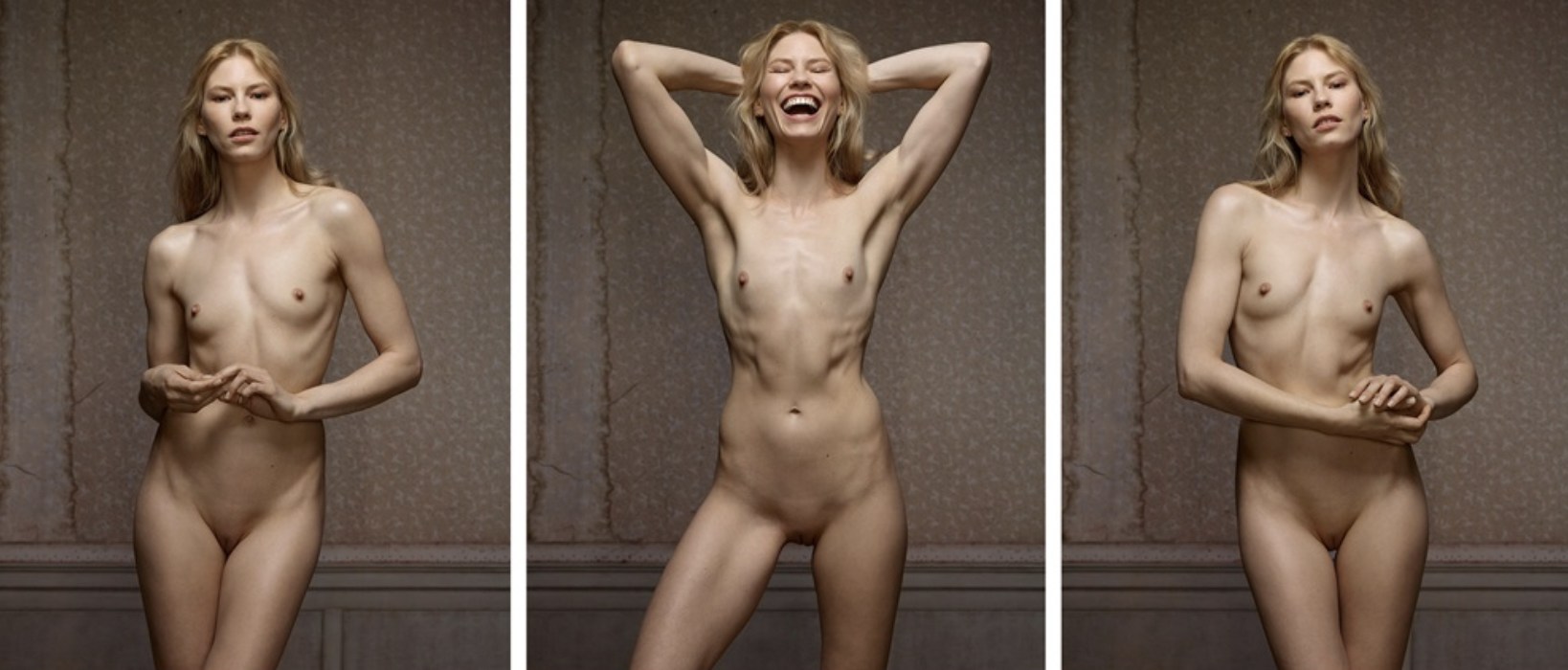
Figure 2: Erwin Olaf, Female Nude 01-03 - Triptych, 2015. Online: https://www.artnet.fr/artistes/erwin-olaf/female-nude-01-03-triptych-a-DZkkjevOQqjqOzCxXmmr8g2
if she is reveling in a moment of laughter or joy. Although it is possible that Olaf instructed his model to pose in this way, it is telling that he chose a posture that connotes confidence and autonomy. The model’s joy and laughter in the middle frame is when she is the most physically exposed out of the three photographs. The result is a very literal opening up of the self that allows for an agreement of viewership between the subject and the onlooker. Whether the model’s smile was her own decision or a product of Olaf’s artistic direction, the result for the viewer is a humanized picture of the female body. Finally, Olaf allows his subject to rest in relatively natural poses that contrast the mannequin-like quality of Newton’s model. Specifically, the woman in Olaf’s work presses her legs together in a way that lacks the stiff ‘thigh gap’ of Newton’s model. This critical distinction embodies Olaf’s appreciation for human corporeality, as his model’s pose indicates an embracing of the natural human form and thus a rejection of unattainable, heterosexual, and gendered beauty standards. Olaf’s photography of the naked human body is not a vehicle for voyeurism or fetishization, but rather a means of offering the body dignity and subjecthood in representation.
From The Nude to The Naked
In line with John Berger’s definitions of the terms, the human bodies in Olaf’s photographs are naked, not nude. Recall that for Berger, to be naked is “to be oneself,” whereas nudity is “to be seen naked by others and yet not recognized for oneself.”[15] Nakedness is to reveal, to be without disguise; nudity is a “form of dress,” a body on display.[16] As such, Berger argues that a naked body becomes nude when it is seen as an object. Accordingly, the models in Olaf’s photography are naked because their nudity is not a form of objectification, but a vulnerable expression of oneself and a study of corporeality. Olaf never wanted nudity to be a form of provocation and ultimately saw it as a “means of looking…carefully and attentively” at the human body.[17] Contrary to Berger’s nude who assumes nudity for a male “spectator-owner,” Olaf’s naked subjects are clothless to “[insist] on the body as a site of beauty in all its forms.”[18]
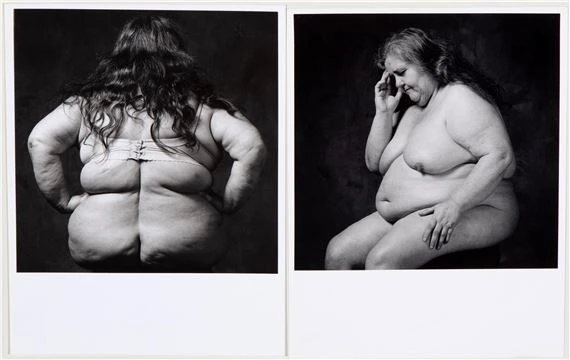
Figure 3: Erwin Olaf, Bra from the series 'Squares' (2), 1987. Online: https://www.artnet.fr/artistes/erwin-olaf/bra-from-the-series-squares-1987-2-g00FIyQoe8Twv_dLG2EPQ2
This transformation of Berger’s nude into the naked is illustrated by Olaf’s 1987 work Bra from the series 'Squares' (2) (Figure 3). The model Marie de Nooyer presents her body from two different perspectives: One from the back, where we can see the unadulterated ripples and cellulite of her skin below her bra, and one from the side, where the viewer gets a glance of the woman’s face in a moment of vulnerability. The juxtaposition between the left and right photographs of the diptych embodies a naked to nude shift because the body transforms from a stiff, rigid pose to one that is authentic, without disguise. Drawing parallels to Figure 2, the right side of Figure 3 depicts a model whose body is natural and relaxed, which contrasts the tense, posed stances that appear on the left side of the diptych and in Figure 1. Specifically, de Nooyer moves from a backwards facing, rigid, hands-on-hips stance to a forwards-facing, natural, seated position. In this shift, her bra is taken off, perhaps symbolizing a break from societal beauty standards and a revealing of vulnerability. The bra on the left acts as a form of dress that draws attention to her nudity; on the right, its absence represents an embodiment of unveiled corporeality, nakedness. The viewer’s ability to see the model’s face in the right photograph is equally significant in marking a shift from objecthood to subjecthood in this diptych.
It is worthwhile to consider how Figure 3 differs from Figure 2 in emotion and body type and how this distinction complicates Olaf’s depiction of the human body. Namely, while the woman in Figure 2 has a thin, muscular, and ‘conventionally attractive’ body, the woman in Figure 3 has thick curves and cellulite. The joy in Figure 2’s model is apparent just as the sorrow is in Figure 3’s. When comparing the two works, a potential contradiction in Olaf’s goal to destigmatize the naked human form arises: Why is a thin body framed with positive emotions while a bigger body is depicted with negative ones? Is Olaf sending a normative message about body size? This is one possible interpretation of Figure 2 and Figure 3’s differences. However, I interpret the latter work as a doubling down on the naked body as a subject, an attempt to illuminate that the human body does not owe the viewer pleasure, sexually or emotionally. Because Olaf worked in fashion photography and was often surrounded by the fashion industry’s strict standards of thinness, his photography of Marie de Nooyer might also represent a radical break from and message of defiance toward conventional beauty standards. Therefore, the discrepancies between Figure 2 and Figure 3 indicate to viewers that expressions of corporeal and emotional vulnerability can exist in photography across body types.
As a standalone work, Figure 3 and its contrasting photographs of the body critically illustrate a transition from the nude to the naked and a shift from objecthood to subjecthood. With its emphasis on human flesh, it expresses Olaf’s “fascination with skin and its capacity to carry vulnerability.”[19] It draws the eye to the imperfections of human skin and makes us inclined to know the model’s story. In sum, Newton’s model in Figure 1 is nude because she is an object on display; Olaf’s model is naked because she is a subject to be understood.
How to Theorize Nudity? Art versus Pornography
As discussed with respect to Figure 2 and Figure 3, Olaf does not use nudity in his photographs to provoke. Inclusion of human genitalia in particular is not intended to spark eroticization or hypersexualization, but is a strategic display of the human body in an honest and pragmatic light. However, Olaf at times faced difficulty in proving that his medium could be used for artistic, not pornographic ends. As he stated in an interview published in IRK Magazine,
...the private part is stolen in photography by pornography, so it is very difficult to photograph nowadays without pornographic content…In painting you can paint a nude body and it is this famous discovering of the world, I don’t know how you call it, this painting of a woman, if it is in a museum or something, as soon as you photograph it, it is porn, but [it is] art.[20]
Here, Olaf underscores the extent to which photographs of the naked human body have developed pornographic connotations in mainstream contemporary society. When the naked body is photographed, it is sexualized; when it is painted, it is artistic. Consider pieces like Olympia by Édouard Manet (Figure 4) and L’origine du monde by Gustave Courbet (Figure 5), two works of nudity that are today considered canonical pieces from early modernist art in Europe. While they were provocative in their time,[21] these works are now, as Olaf observed,
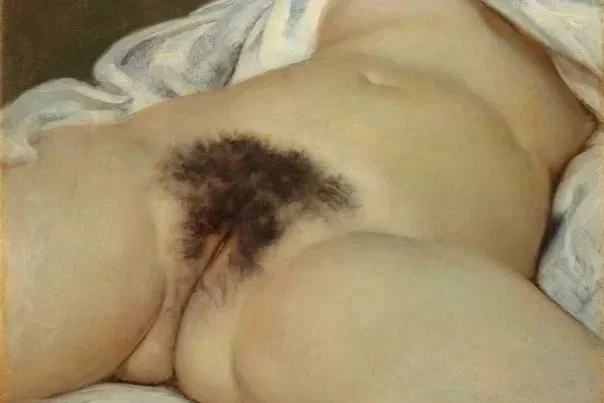
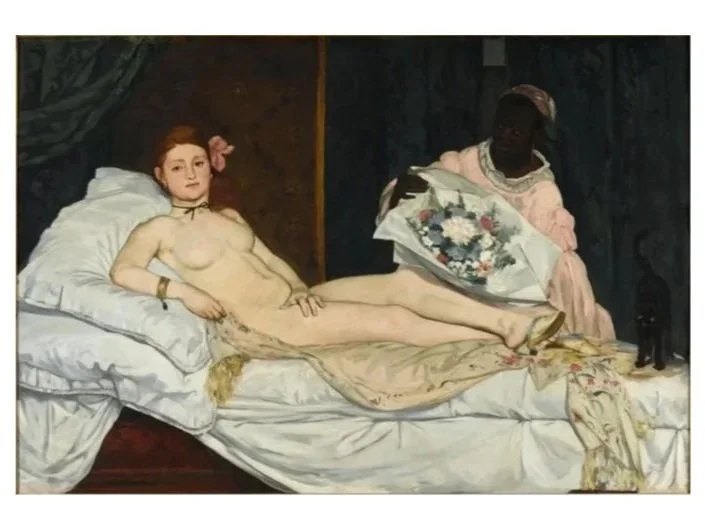
‘famous’ in the Musée d’Orsay, a world-renowned museum. Olaf thus sought to photograph the naked human body with the same artistry as painting and to disrupt the dichotomy between pornography and art by giving the naked body dignity in photographic representation.
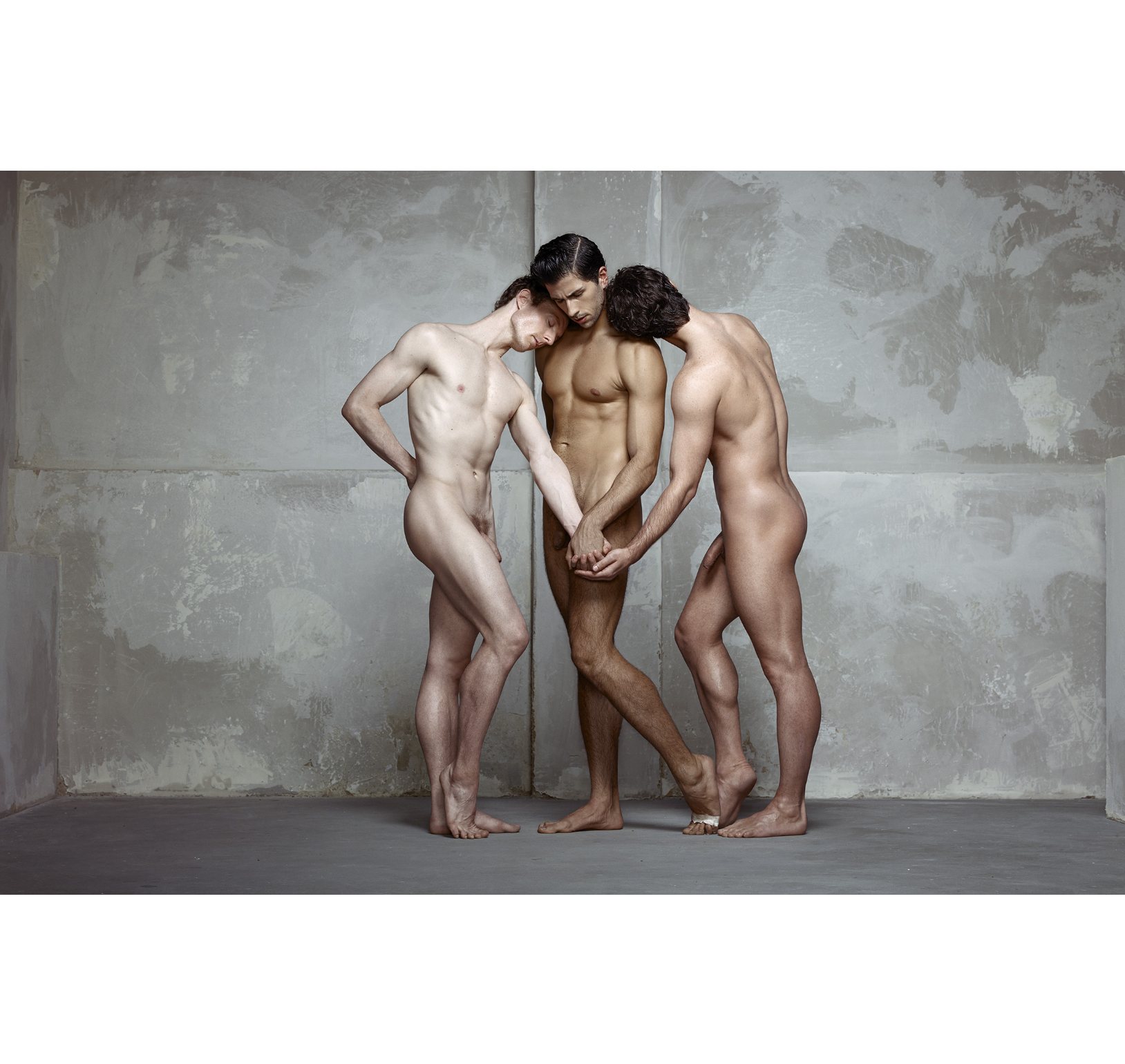
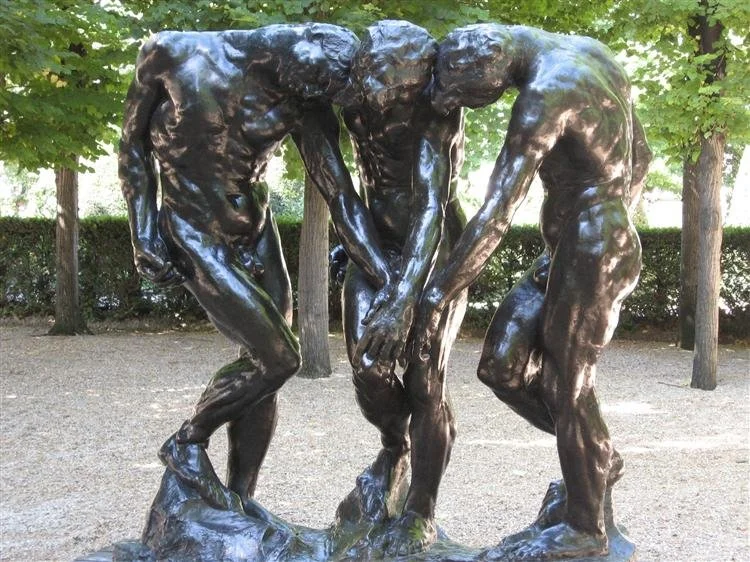
One such way Olaf achieved this was by reappropriating tropes in already existing art. Namely, he employed French sculptor Auguste René Rodin as a source of inspiration for his 2016 series After Rodin. In it, he photographs dancers as they pose in stances that mimic those of Rodin’s renowned sculptures. This series was not only an homage to Rodin, but also a way for Olaf to solidify the artistry of his photography. In The Three Shades (Figure 6),
Olaf positions his models in the same pose as the sculptural bodies in Rodin’s work of the same title (Figure 7). In doing so, Olaf makes a statement about nudity: The naked human body in photography, just as in painting or sculpture, can indeed be art. By referencing high art and detailed human craftsmanship, Olaf rejects pornographic connotations of human nakedness. Instead, Olaf affords the naked human body of the three figures visibility, dignity, and subjecthood in photography.
Subverting The Heterosexual Division of Labour
By photographing the body in an intentionally artistic and corporeal light, Olaf’s photography subverts Mulvey’s conception of the heterosexual division of labour. Specifically, Olaf disrupts Mulvey’s notion that women bear the burden of spectacle or objecthood for men’s desire and that men, by way of heterosexual hierarchy, control the narrative about women. This passive/active gendered split is embodied in Newton’s Self-Portrait with Wife and Models, Paris, Vogue Hommes.
Contrastingly, when examining the selected works of Olaf (Figures 2, 3, 6), they are not produced through a heterosexual lens. This is not merely the case because Olaf himself was a gay man—though it certainly contributed to his positionality as a photographer—but rather because his frame of reference is not one of heterosexual normativity. Namely, Olaf decenters the heterosexual male gaze by affording his models, irrespective of gender, a full sense of subjecthood that exists beyond the constraints of heterosexuality. A key example of this is Olaf’s 2022 piece Kleines Requiem - I (Figure 8), an intimate work which features the emotional and corporeal connection between two male dancers. While this is perhaps an obvious example for its explicit feature of queerness, the other works discussed thus far also exemplify a breaking down of the active/passive gendered and heterosexual split that Mulvey theorizes.
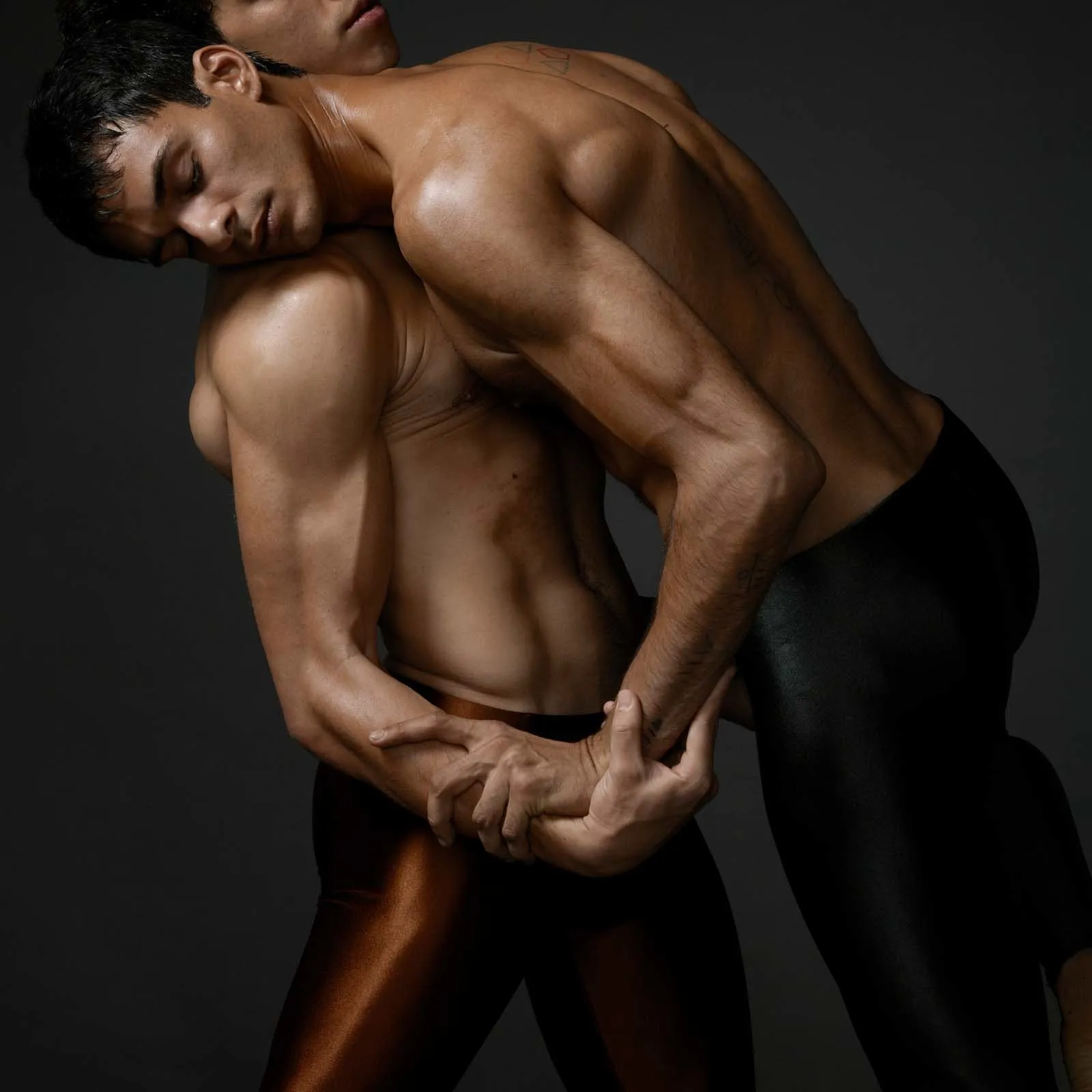
Figure 8: Erwin Olaf, Kleines Requiem - I, 2022. Online: https://www.artnet.fr/artistes/erwin-olaf/kleines-requiem-i-a-47zTV_mhWOXsTPg1OUJdrQ2
Mulvey sees a necessary divide between the active male subject and passive female object and argues that the former cannot possibly ‘change places’ or bear the burden of sexual objectification himself.[22] Instead of interrupting this dichotomy by rendering the woman the subject and the man the object, Olaf’s photography goes beyond the bounds of Mulvey’s heterosexual binary by disrupting it entirely. That is, he gives all bodies, irrespective of their gender, a sense of subjecthood by capturing them with vulnerability.[23] Bodies are not mere gendered or sexual icons for Olaf, but reminders of corporeality and humanness. As such, Olaf rejects the “economy of heterosexual desire” by opting instead for a freer expression of bodiliness.[24] He is successful in doing so by photographing the human body not for what it does, but for what it is.[25]
Queering The Gaze
Thus far, I have argued that Olaf’s photography of the naked human body transfigures nudity from voyeurism, objecthood and pornography to corporeal appreciation, subjecthood and art. How, then, do these transformations constitute a queering of the gaze? Importantly, ‘queering the gaze’ does not primarily refer to Olaf’s positionality as a queer photographer and the gaze with which he sees his subjects. Rather, it is a question of his ability to transform and queer the gaze of the viewer. For queer theorist Jack Halberstam, “queer” is what exists in opposition to the norm.[26] It is a “temporality” and “potentiality” that disrupts certain “paradigmatic markers of life experience” like heterosexuality and the institutions that accompany it.[27] In this way, aligning with Foucault’s description of the term, to queer is about threatening the status quo as a “way of life” rather than a “way of having sex.”[28] It is through these definitions of queerness that Olaf’s photography queers the gaze.
When Olaf transforms a trope—the naked human body—that is so often co-opted by pornography or other voyeuristic photography as something to be sexualized and objectified into a study of subjecthood and corporeality, he is queering the gaze. It is precisely through his rejection of normative conventions surrounding nude photography that his works queer the gaze of the viewer. By representing the naked human body as a subject, he disrupts our expectations of what we are accustomed to seeing, and thus what we are socialized to think, vis-à-vis nakedness. He challenges us to look beyond connotations of pornography or objectification and to examine the human body within what Halberstam deems an “imaginative” or “queer temporality.”[29] Olaf’s work forces the viewer to confront one’s preconceived notions about nudity and to reinterpret the body in ‘queer’ or non-normative ways. Olaf thus queers the gaze by reappropriating nude photography and subverting the expectations that accompany it.
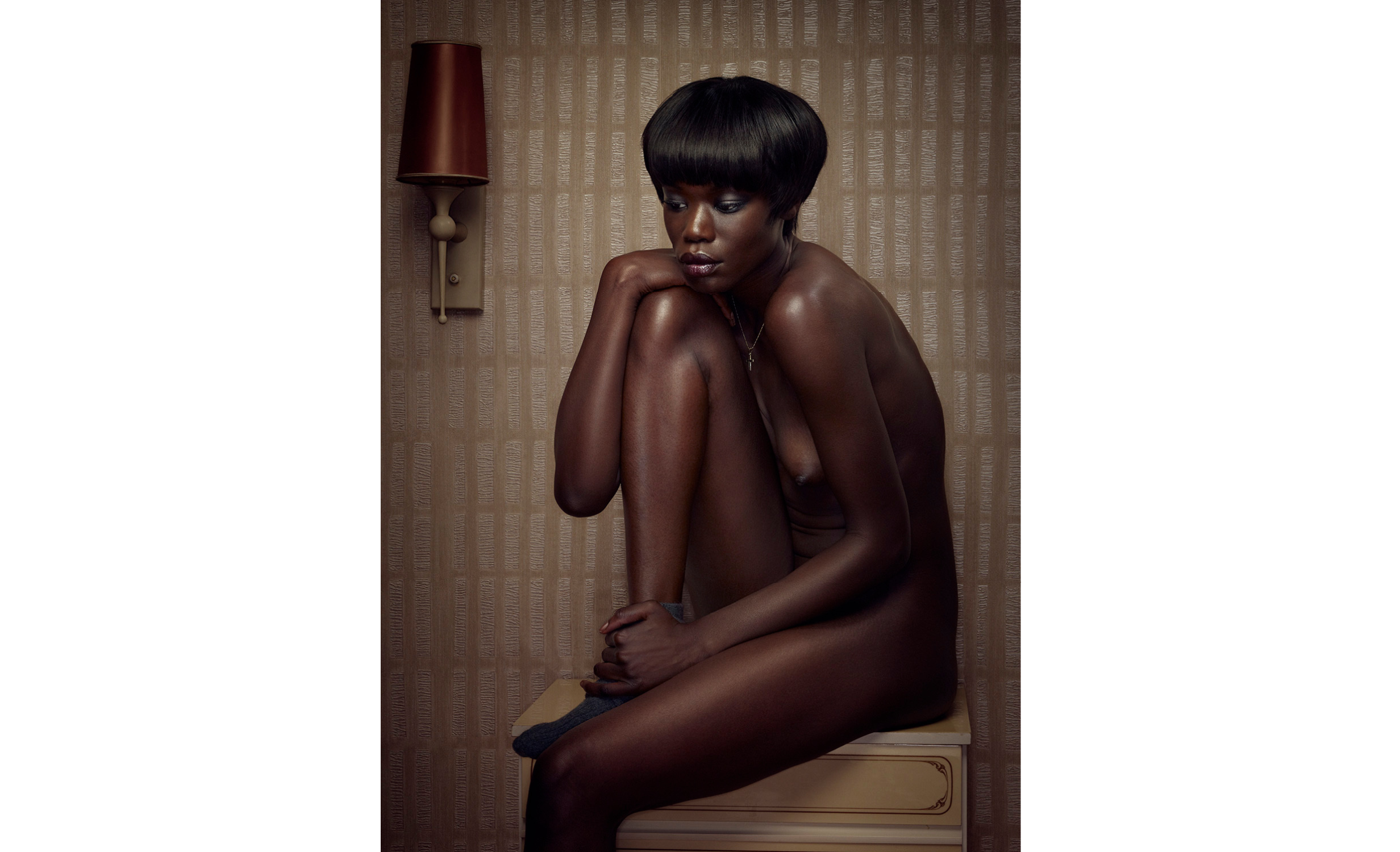
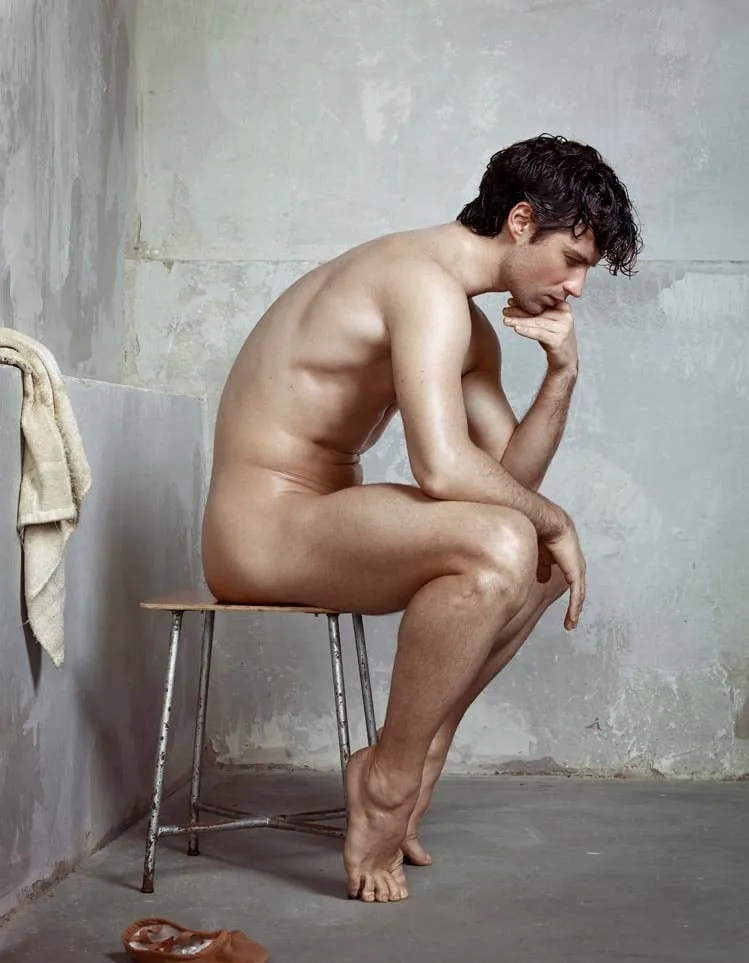
Moreover, Olaf’s photography constitutes a queering of the gaze because it rejects gender essentialism. He frames all bodies, irrespective of their gender, in a similar way, enabling him to disrupt Mulvey’s active/passive gendered split between objecthood and subjecthood. For instance, both Olaf’s 2010 piece Hotel - Winston Salem, Sarah Portrait (Figure 9) and his 2016 piece The Thinker (Figure 10) allow the body to relax in parallel, pensive poses that do not
Alternative Perspectives
Olaf’s photography reappropriates the gaze vis-à-vis the naked human body. To what extent can this be disputed? The following section will consider potential alternative perspectives and questions that might challenge or raise gaps within my argument.
1) How do we decouple the naked body from sexual objectification?
In this paper, I have argued that Olaf transforms the naked body from something to be sexualized and objectified into an entity to be appreciated for its corporeality and subjecthood. However, one might question whether we can truly separate images of nudity from their societal connotations. To what extent are Olaf’s photographs a genuine de-hypersexualization and de-objectification of the body if they exist in a society that tends to view skin and flesh as inherently taboo? Mulvey, for instance, might challenge my argument by contending that the naked female body is intrinsically tied to visual pleasure and male-centric voyeurism because of the omnipresence of the male gaze in our lives. How do you prevent viewers from sexualizing Olaf’s subjects? Do his photographs necessarily ‘queer’ the gaze of every viewer?
I would first respond to these questions by underscoring the range of body types that Olaf includes in his works. Specifically, “it did not matter to Olaf what his subjects looked like,”[31] and he often photographed types of bodies that are not usually featured in conventional tropes of the nude body. Observe, for example, the difference in body shape between Figure 2 and Figure 3. This variation may be used as evidence of Olaf’s queering of the gaze because he defies normative expectations of what nudity ‘should’ look like. Berger’s distinction between the nude and the naked may further argue that Olaf is able to decouple the body from sexual objectification by making a transformation from the former to the latter. Nevertheless, these questions pose potential gaps in my argument and illustrate that, perhaps, a queering of the gaze cannot be guaranteed.
2) Can pornography be art?
In his photography practice, Olaf explicitly rejects his works as pornographic, instead defining his nude photography as art. In doing so, he creates an implicit dichotomy between pornography and art. However, are these two necessarily mutually exclusive? Beyond Olaf’s references to existing art like Rodin’s sculptures, what distinguishes between nude photography as art versus pornography? I have argued that Olaf eschews pornographic connotations by representing his models with dignity and subjecthood; is it not also possible to give subjects the same type of dignity in certain kinds of pornography?
In response to this perspective, Olaf would likely take a Kantian approach and argue that his photography distinguishes itself from pornography because he treats his models and their bodies as ends in themselves. Specifically, according to Kant’s second “categorical imperative,” one should not use another person as a means to an end.[32] Accordingly, Olaf might argue that pornography, which uses the naked human body to evoke sexual pleasure on the part of the viewer, violates Kant’s categorical imperative. In contrast, Olaf takes the human body at face value and captures it for itself; this emphasis on raw corporeality over sexuality is how he provides the naked body with dignity and visibility in representation. It is through Olaf’s aim to photograph the body for ‘what it is’ and not ‘what it does’ that he distinguishes himself from pornography and rejects the possibility of pornography as art.
Conclusion
Overall, I have argued that Erwin Olaf’s photography of the human body represents the naked human form as a subject through its emphasis on corporeality and its rejection of voyeurism and heterosexual desire. By reframing nudity as a form of art rather than pornography, Olaf queers the gaze of the viewer, disrupts gender essentialism and converts the nude into the naked. Using Laura Mulvey, John Berger and queer theory as a theoretical framework, I have demonstrated how Olaf’s works subvert the heterosexual division of labour and disrupt the gendered divide between objecthood and subjecthood. Consequently, he affords his subjects dignity, visibility and care in representation.
Questions about decoupling nudity from sexual objectification and the extent to which queering the gaze of the viewer is a guaranteed outcome of Olaf’s photography constitute challenges to my argument. Moreover, discussion of how nude photography enters the arenas of art and pornography and whether these two are necessarily mutually exclusive, pose points of further exploration. While these questions may be examined further in continued research on this subject, it remains clear that, in Bergerian terms, Olaf has transformed our ‘ways of seeing’ the naked human form. Ultimately, Olaf’s photography of the human body challenges common conceptions and conventions about photographing nudity, and raises broader questions about the ethics of bodily representation.
Endnotes
[1] Getty Museum, “In Focus: The Nude,” Getty, 2007, https://www.getty.edu/art/collection/exhibition/103P5D.
[2] In the context of this paper, I define heterosexual desire as sexual desire between men and women, with specific attention to how men objectify women, even if subconsciously, in their attraction to the opposite gender.
[3] Voyeurism refers to looking at another person as an object; “sexual satisfaction…from watching, in an active controlling sense, an objectified other” (Mulvey, 1975). I use the adjective “male-centric” to focus on men being voyeurs to women, specifically with respect to art and photography.
[4] Laura Mulvey, “Visual Pleasure and Narrative Cinema,” Screen 16, no. 3 (1975): 6-18, doi: https://doi.org/10.1093/screen/16.3.6.
[5] Mulvey, “Visual Pleasure and Narrative Cinema,” 1975.
[6] Mulvey, “Visual Pleasure and Narrative Cinema,” 1975.
[7] Ways of Seeing by John Berger is a series of seven essays, based on his 1972 BBC series, that examines Western cultural aesthetics and how we view art. Three of his seven essays are entirely pictoral (John Berger, Ways of Seeing (Penguin Books, 1972).
[8] John Berger, Ways of Seeing (Penguin Books, 1972).
[9] Berger, Ways of Seeing, 1972.
[10] Berger, Ways of Seeing, 1972.
[11] Artnet Gallery Network, “The Enduring Relevance of Erwin Olaf, Dutch Photographer and LGBTQ+ Rights Advocate,” Artnet, February 23, 2026, https://news.artnet.com/art-world/gallerist-ron-mandos-erwin-olaf-274735.
[12] Thomas Werner, “The First Movement, Erwin Olaf,” IRK Magazine, 2018, https://www.irkmagazine.com/post/the-first-movement-erwin-olaf-by-thomas-werner/.
[13] Werner, “The First Movement, Erwin Olaf,” IRK Magazine.
[14] Mulvey, “Visual Pleasure and Narrative Cinema,” 1975.
[15] Berger, Ways of Seeing, 1972.
[16] Berger, Ways of Seeing, 1972.
[17] Galerie Ron Mandos, “Tender Fury,” Ron Mandos, 2026, https://ronmandos.nl/exhibition/tender-fury/.
[18] Berger, Ways of Seeing, 1972; Galerie Ron Mandos, “Tender Fury,” Ron Mandos.
[19] Galerie Ron Mandos, “Tender Fury,” Ron Mandos.
[20] Werner, “The First Movement, Erwin Olaf,” IRK Magazine.
[21] Rebecca Rabinow, “Édouard Manet (1832-1883),” The MET, October 1, 2004, https://www.metmuseum.org/essays/edouard-manet-1832-1883; Tim Smith-Laing, “Who Commissioned the 19th Century’s Most Notorious Painting?” Frieze, October 2, 2019, https://www.frieze.com/article/who-commissioned-19th-centurys-most-notorious-painting.
[22] Mulvey, “Visual Pleasure and Narrative Cinema,” 1975.
[23] Galerie Ron Mandos, “Tender Fury,” Ron Mandos.
[24] Krystian Gradz, “Queering the (Camera) Matrix: Male Body Aesthetics in Erwin Olaf’s and Ruven Afanador’s Photography,” Er(r)go: Theory-Literature-Culture 41 (2020): 163-173, doi: https://doi.org/10.31261/errgo.830.
[25] Gradz, “Queering the (Camera) Matrix,” 2020.
[26] Jack Halberstam, “Queer Temporality and Postmodern Geographies,” in In a Queer Time and Place: Transgender Bodies, Subcultural Lives (NYU Press, 2005): 1-6.
[27] Halberstam, “Queer Temporality and Postmodern Geographies,” 2005.
[28] Halberstam, “Queer Temporality and Postmodern Geographies,” 2005.
[29] Halberstam, “Queer Temporality and Postmodern Geographies,” 2005.
[30] Judith Butler, “Performative Acts and Gender Constitution: An Essay in Phenomenology and Feminist Theory,” Theatre Journal 40, no. 4 (1988): 519-513, doi: https://doi.org/10.2307/3207893.
[31] Galerie Ron Mandos, “Tender Fury,” Ron Mandos.
[32] Immanuel Kant, The Metaphysics of Morals (Cambridge University Press, 2017).