
As the Badshāh Saw with Basīra:Bichitr’s Albumic Reordering of the Renaissance
Written by Selena Syed, University of Toronto
Edited by Anna Robinson and Nitya Khirwar
Introduction
The scholarship of the Renaissance, once charted along securely bounded European trajectories, has unbounded into an increasingly global map of exchanges, negotiations, and reframings. What circulates across the world is not only the visuality of prints and paintings but their far more elusive vision of a cross-cultural phenomenon; within this Global Renaissance, the gaze cannot be considered universal as there is no singular visual regime to which Europeans and non-Europeans alike can be subordinated. This assumption of the singular collapses with Bichitr’s miniature of Jahāngīr Preferring a Sufi Shaikh to Kings (c. 1615–18) (Fig. 1). Since the arrival of European works into the Mughal Empire, the ‘western’ images were not seen as models to imitate but as provocations to be interrogated, miniaturized, and reordered within a distinctly Islamic translation.
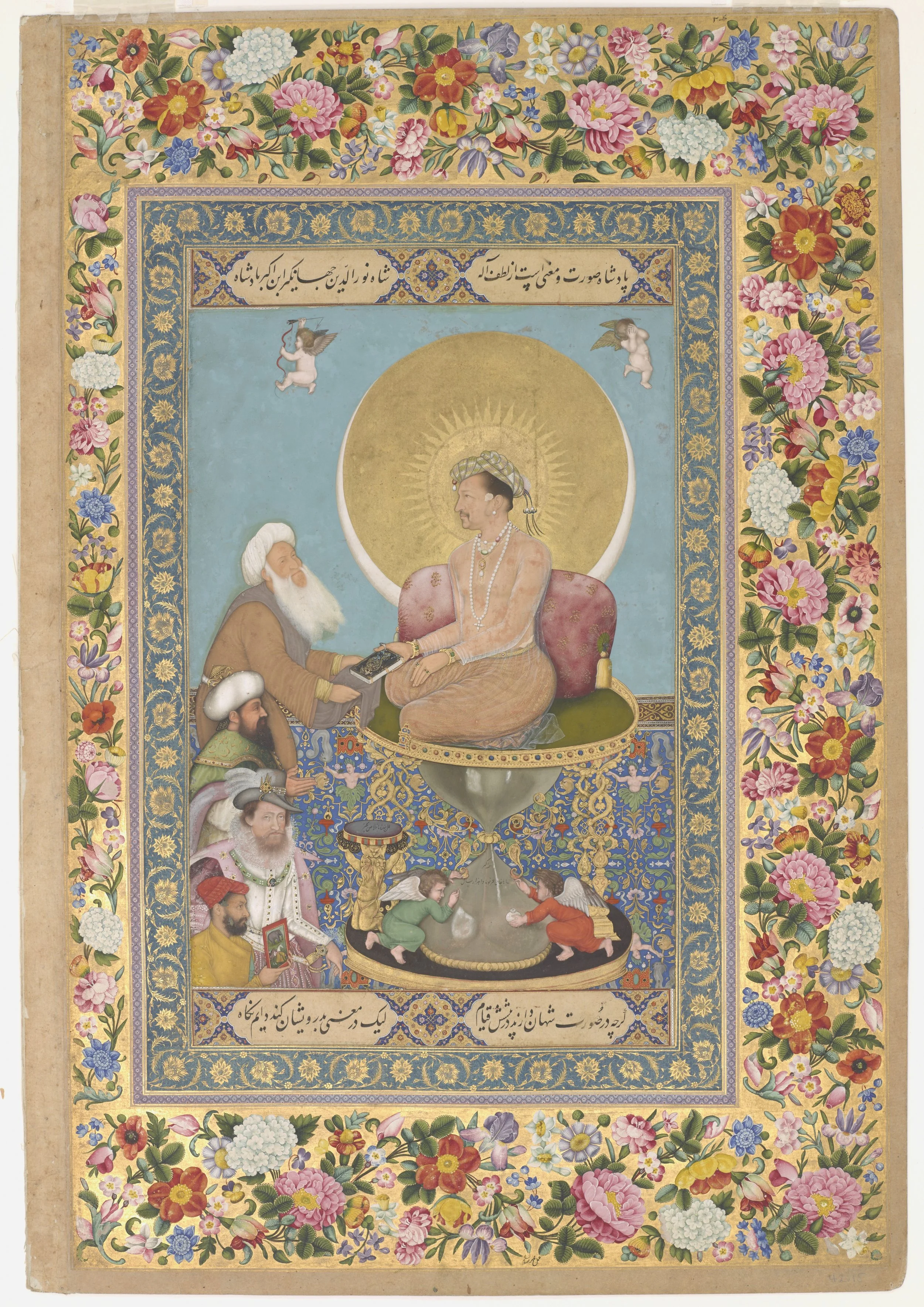
Fig. 1. Bichitr, Jahāngīr Preferring a Sufi Shaikh to Kings, ca. 1615–1618. Opaque watercolor, gold, and ink on paper; 18 × 13 in. Smithsonian National Museum of Natural History, Washington, DC. https://asia.si.edu/explore-art-culture/collections/search/edanmdm:fsg_F1942.15a/.
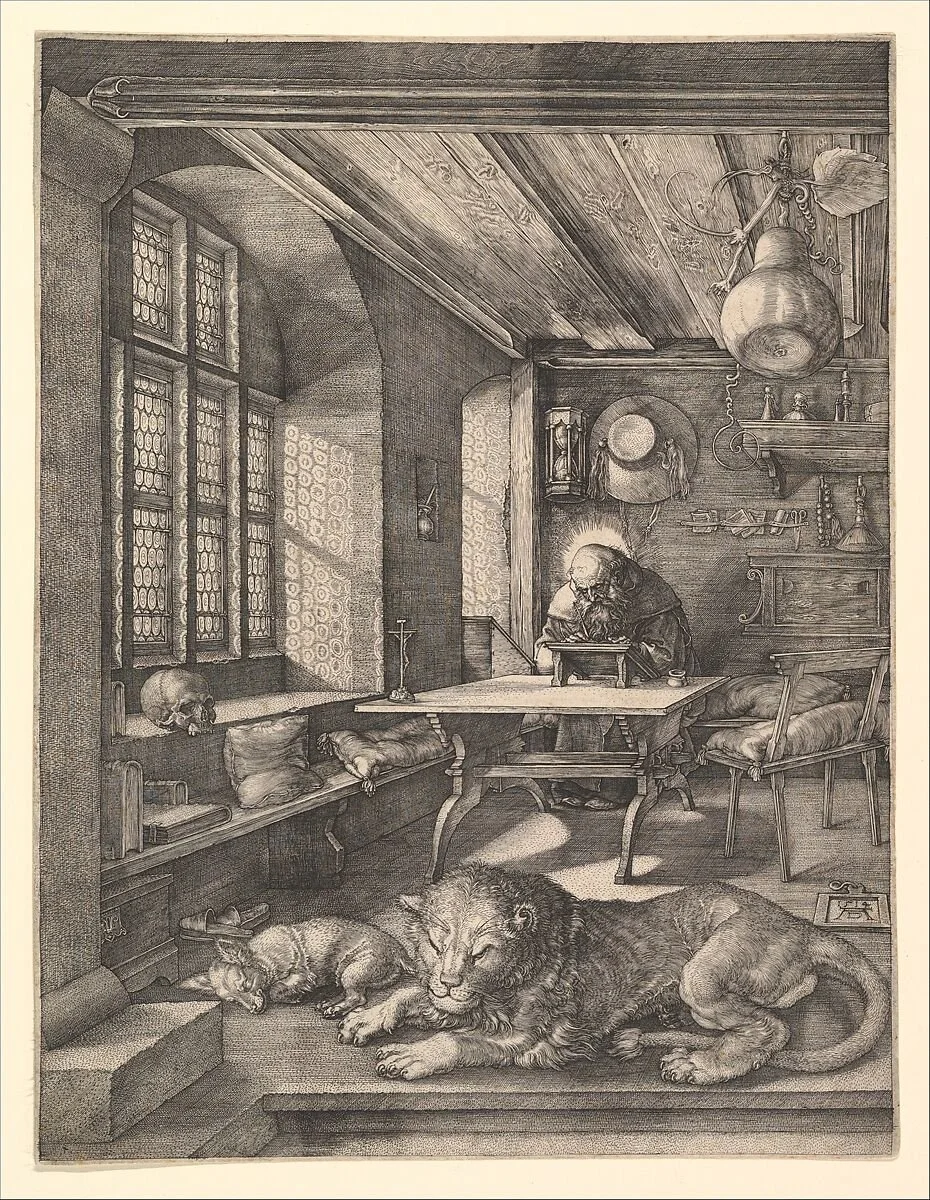
Fig. 2. Dürer, Albrecht. Saint Jerome in His Study. 1514. Engraving; 9.6 × 7.5 in. The Metropolitan Museum of Art, New York. https://www.metmuseum.org/art/collection/search/336229.
The miniature represents a dissonance not between styles, nor even between empires, but between ways of seeing. Within the gold margins of the imperial murraqaʿ (album), Bichitr articulates an epistemology of vision, baṣīra, the Sufi-inflected inner sight, through which Jahāngīr discerns and orders the world. The badshāh’s (emperor’s) gaze, halo, and hourglass throne do not simply signify political power; they visualize nūr (divine radiance) and ʿilm (experiential knowledge) as the true grounds of authority. This will ground the argument that Bichitr’s miniature reorders the Renaissance humanist vision of reason as the authority of sovereignty into an Islamic Sufi visual hierarchy of baṣīra, and what this reordering demands of Global Renaissance historiography. Bichitr does not simply respond to the European precedents. He theorizes a system through which European kings, prints, and technologies are seen through the Islamic gaze.
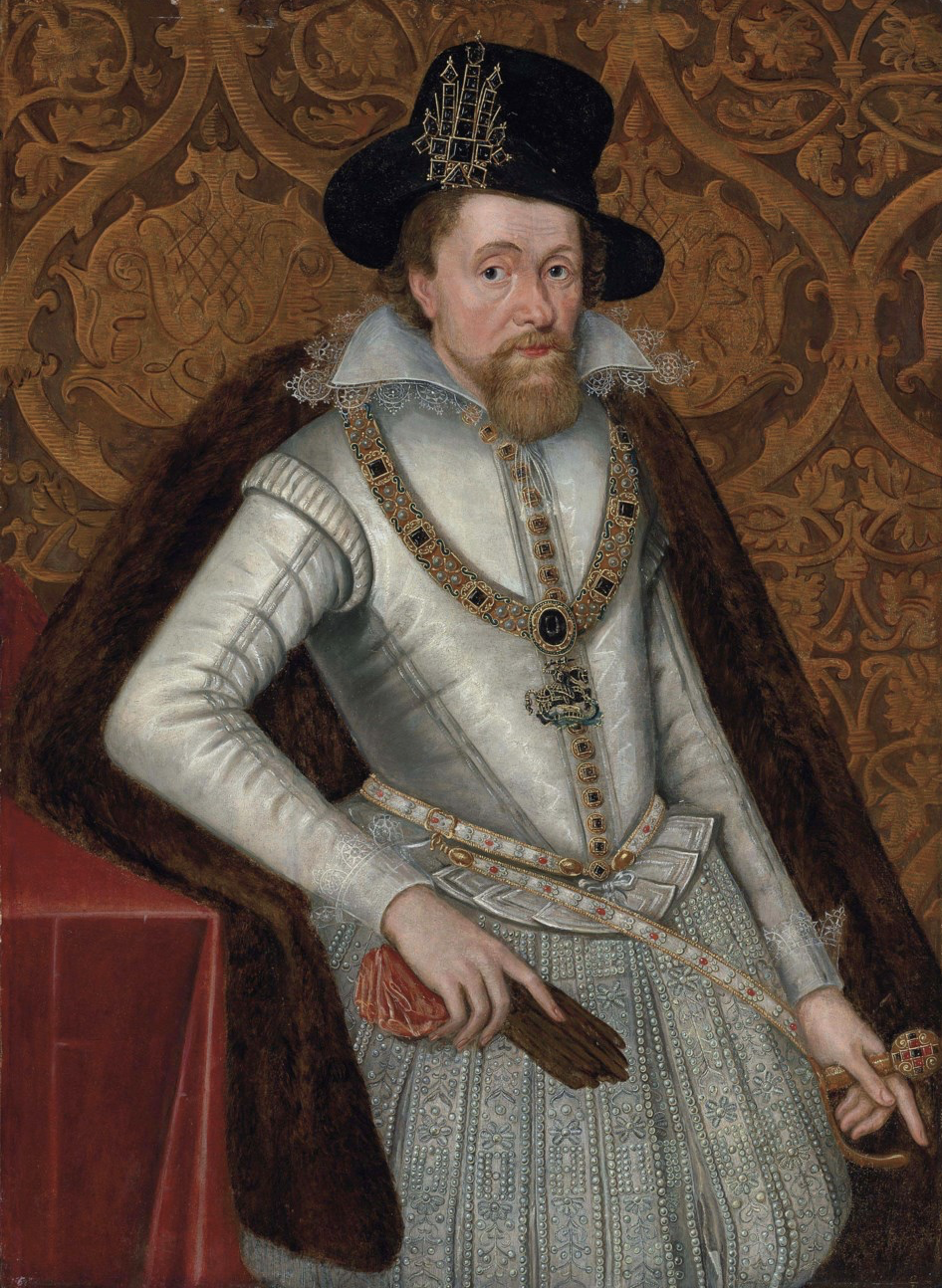
Fig. 3. de Critz, John. Portrait of King James I of England and VI of Scotland. 17th century. Oil on panel; 45 × 32.5 in Private collection, Christie’s, London. https://www.christies.com/lot/lot-5521212/?intObjectID=5521212.
In doing so, he does not just participate in the influence, circulation, or hybridity that often structure Global Renaissance narratives. Rather than presenting a neutral space of exchange in which European and Mughal visualities meet on equal terms, Bichitr reorders Renaissance humanism itself, its solitary, rational, and finite ideologies, inside a Sufi epistemology. A comparison of the miniature with Albrecht Dürer’s engraving, Saint Jerome in His Study (1514) (Fig. 2), along with John de Critz’s painting of the Portrait of King James I of England and VI of Scotland (17th cen.) (Fig. 3) and Bichitr’s Portrait of James I (ca. 1615-18) (Fig. 4), indicates a shift from global influence to analyzing how the Mughal courts actively reordered the European gaze.
This global influence, studied in Sanjay Subrahmanyam’s “A Roomful of Mirrors,” has become foundational for theorizing early modern Eurasia as a region of visual, reciprocal, and diplomatic engagements. He criticizes the habit of narrating encounters “essentially as one of a growing European presence in and influence on Asia … with relatively little attention paid to the other half of the circle.”[1] The diplomacy in which these works travelled is one of the privileged sites where that circle was “indeed closed,” particularly through an artful embrace of Mughals and Franks.[2] His metaphor of a roomful of mirrors, empires reflecting back at one another, suggests bilateralism: each court projects and receives images of the other, and Global Renaissance scholars have often followed this lead.
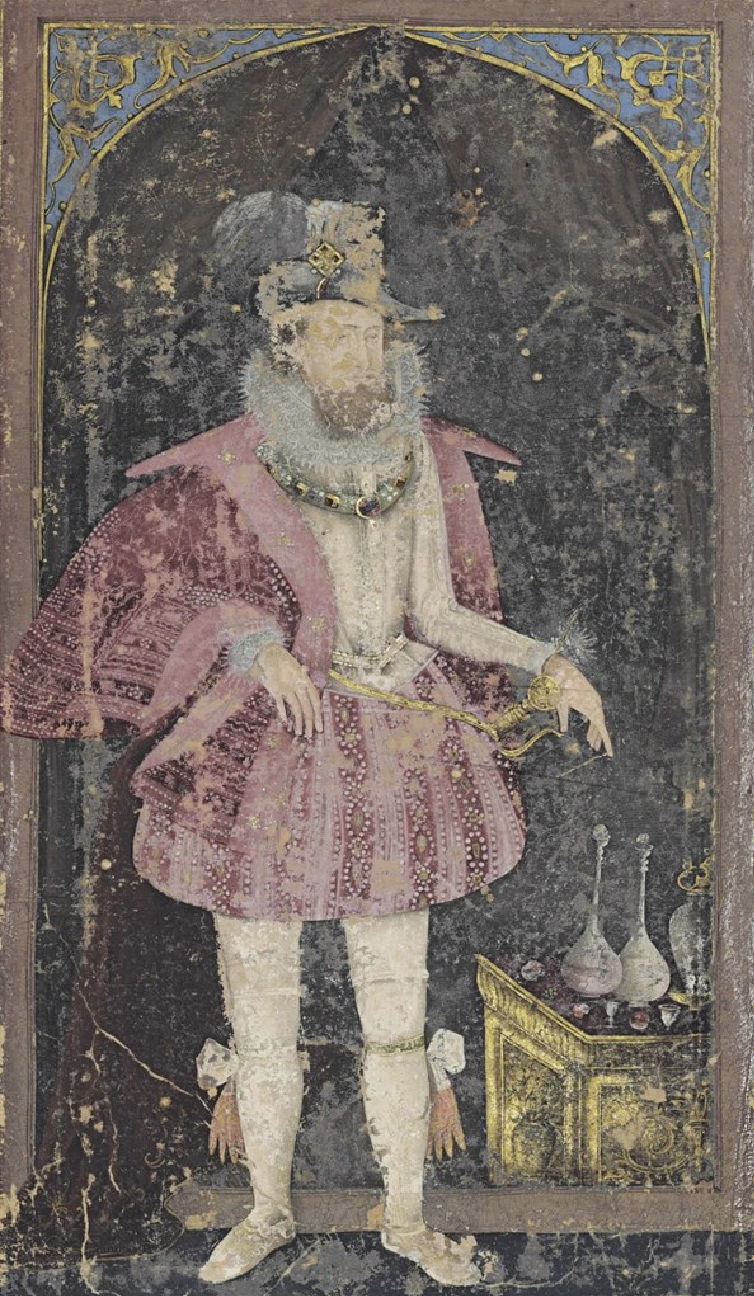
Fig. 4. Bichitr, A Rare Mughal Portrait of James I. ca. 1615-18. Opaque watercolor, gold, and ink on paper; 7.87 × 4.5 in Private collection, Christie’s, London. https://www.christies.com/en/lot/lot-5930930
Bichitr’s miniature extends that symmetry. Europe is undeniably present where King James I stands at the lower register; the linear modeling and hatched shading of European printing fades in the baroque textiles, sculptural caryatid, and perhaps even the carefully rendered hourglass. Yet, despite Bichitr’s mastery of European visual techniques, the image does not function as a mirror for the European gaze, instead employing the baṣīra. Unlike the other Islamic figures in attendance, James does not look back at Jahāngīr, but instead the viewer, unable to gaze. The badshāh, elevated on his throne, rather meets the gaze of the shaikh (Islamic scholar). Subrahmanyam insists on “a relation of methodological, observational, and conceptual disparity between paradigms,” to which Bichitr stages precisely.[3] The miniature makes visible a world in which the Mughal court occupies a “cultural zone…largely inaccessible to those who look in from the outside,” including, crucially, European beholders.[4] That very roomful of mirrors turns out to be a room in which not all mirrors have equal reflections.
This asymmetry is epistemic; that “hundreds, if not thousands, of pages have been devoted to the transformation of Mughal art under European influence,” thus advancing the argument.[5] What has often been read as stylistic influence, circulation, or hybridity must be reconceived as the translation of humanist ideologies into Sufi epistemologies. The question is not what Europe did to Mughal art but how Mughal artists made Europe legible within their own gaze, and how they reordered Renaissance humanist visuality.
Yael Rice’s “The Brush and the Burin” shifts the focus from diplomacy to material practice, tracing how European engravings were gathered into Jahāngīr’s murraqaʿ and reworked in the Mughal atelier. She notes that official records say little about European travellers, but the visual record presents a different case: Mughal paintings of Jesuit priests and figures in European dress reveal a “deep interest in Europeans and European visual culture.”[6] Rice argues that Mughal artists were “heirs to an artistic tradition concerned primarily with the line and contour, especially Persian and Arabic calligraphy,” and that European prints were attractive precisely because they fit easily into this established system.[7] The murraqaʿ, she writes, presents “an ideal entry into the question of how engravings were received at the court,” since its organization reveals how European prints were assimilated alongside painting and calligraphy.[8]
Rice thus reframes engravings as technical and material resources rather than scripts to be passively copied. Her most pointed claim is that the incorporation of engravings into the murraqa had “more to do with an interest in the effect and finish—in sum, the look—of prints…than in their subject matter.”[9] That look, in the hands of Bichitr, is not merely a surface effect. It becomes a vessel for re-staging relationships of the baṣar (outward sight), between line as calligraphic trace and line as European modeling. Rice further argues that the albumic environment she describes is not only a place where one houses engravings, but a technology that trains how one sees.
Kavita Singh, in “Real Birds in Imagined Gardens,” pushes this framing even further towards an understanding of Mughal painting as a system in which vision is political over purely visual. She argues that Mughal painting had “begun in the middle of the sixteenth century as an offshoot of Persian painting…transformed through contact with the European Renaissance.”[10] Mughal painters absorbed “elements of naturalism, chiaroscuro, and perspective,” yet remained “purposefully selective in their use of European elements.”[11] Singh’s contrast between real birds; the observed, and imagined gardens; the conceptual, already implies a distinction between the baṣar and the baṣīra.
Rice shows us the technical and albumic mechanisms of encounter, whereas Singh reveals a visual culture where naturalism serves hieratic and political ends. These scholars, in different ways, collapse any notion of Mughal artists as imitators. Together, their insights provide the frameworks for the argument that Bichitr visualizes a Sufi hierarchy of baṣīra over baṣar, and that the murraqaʿ operates not only as a site of curation, but as the material architecture through which that hierarchy is enacted. Where existing paradigms emphasize influence, circulation, or hybridity, the system here is in reordering: Bichitr takes Renaissance humanism and translates it into Islamic Sufism.
Bichitr: Jahāngīr Preferring a Sufi Shaikh to Kings
To understand this reordering, Jahāngīr Preferring a Sufi Shaikh to Kings must first be treated not as an illustration of a known doctrine, but as an artefact that actively thinks, one that theorizes sight through its own internal logic.The miniature stages a distinct model of sight: one grounded in baṣīra (inner vision), structured through ʿilm(experiential knowledge), and illuminated by nūr (divine radiance). These are not decorative elements but the operative principles at work.
At the center, Jahāngīr is encircled by a halo of gold and silver, a visual manifestation of nūr, the emanation that is brighter than the sun and yet colder than the moon. It does not cast shadows, though it floods the badshāh’s figure and the field behind him soon. Entering the world from within, light here has not a physical but metaphysical status: a symbol that his authority is grounded in divine radiance rather than in human reason alone.
As nūr names the condition of illumination,ʿilm names the quality of knowledge that this light confers. Bichitr encodesʿilm in the relationship between the badshāh and the shaikh, who receives this imperial gift. The shaikh is the first of his attendants; positioned at the top of the vertical hierarchy, his plain garb contrasts the heavy regalia of the two rulers below. He leans into Jahāngīr, their gaze met across the radius of the halo as he accepts the book with a cloth. These gestures of humility nonetheless mark his precedence, signaling that spiritual knowledge outranks worldly rule. The vertical order is not a courtly procession but a diagram ofʿilm. The shaikh stands where knowledge originates, Jahāngīr where it is refracted into rule, and the courtiers only where it is observed.
It is then through baṣīra, that this hierarchy becomes legible; the spiritual truth that is apprehended beyond the deceptive surfaces of baṣar. Below the shaikh, the foreign Ottoman Sultan and British King are pushed to the lower register of ‘ilm, outside the axis of nūr. Whereas the Islamic sultan can see the badshāh with baṣīra, the king, who cannot, gazes back regrettably at the viewer. Here, the true sovereign is not one who sees more, but one whose vision is bestowed towards sanctity. This seeing is as well the condition that enables Jahāngīr to transcend the mortal realm. His emptied hourglass throne, through which his time is collected by cherubs, becomes an axis mundi; no longer an external disciplining force, but the subordinated pedestal that he sits upon.
Albrecht Dürer, Saint Jerome in His Study
Contrasted to this Sufi regime, Albrecht Dürer’s Saint Jerome in His Study embodies the visuality that Bichitr ultimately reorders: a Renaissance humanist ideology in which order is rational, solitary, and finite. The engraving, known to have circulated in the Mughal empire through Jesuit missionaries, offered artists not only a new form of technical modeling but also a new mobilized visual ideology. The parallel will hinge on the counterpoints that both artists share, in opposing ways, through their subject and in their relation to their concepts behind the light and the hourglass.
Dürer constructs a world in which illumination is rational: physical before it is metaphysical. Light enters the studiolo through a window, traveling a measurable path, and falls within the consistent behaviour of linear perspective. A modest halo even occurs through Jerome’s meditation, but is ultimately subordinated to this former source. Unlike nūr, divine presence is acknowledged, but such that it is secondary to the rational illumination that structures the space.
Jerome sits in solitude at his desk, immersed in the discipline of writing. Knowledge here is not bestowed through ‘ilm’s relational proximity to sanctity but is generated through ascetic practice. The saint becomes inseparable from his labour, governed by time as the draining hourglass above him marks his passage of the finite. Its function is that of a memento mori, opposing the axis mundi; time does not yield to him, and instead Jerome is visualized within the progression of earthly time.
Bichitr and de Critz: James I.
Having established how Dürer visualizes humanism, we can then trace how the engraving was confronted and translated in the Mughal atelier. The figure of King James I in Jahāngīr Preferring a Sufi Shaikh to Kings can be traced to a portrait by John de Critz.[12] The painting is believed to have been gifted to Jahangir by a British ambassador to the Mughal court. In de Critz’s painting, James appears as a sovereign subject in three-quarter view, elaborately robed, with his hand resting on the hilt of his weapon. The portrait is a precis of Renaissance humanism: a ruler whose authority is legible for a viewer who shares the same mirror world.
Bichitr’s engagement with this image is deliberately selective. In his separate miniature of a Portrait of James I, he follows the painted model closely, signaling direct recourse to de Critz while demonstrating his mastery of European technique. Yet when James reappears in Jahāngīr Preferring a Sufi Shaikh to Kings as a courtier, he is no longer a focal subject. He has been disarmed, compressed into the lower tier of the composition, with his body scaled down in relation to that of Jahāngīr’s. Who was once the central European authority became a mere participant in the Mughal hierarchy. He does not reach the badshāh through gifts, his gaze is misaligned, and his body is visually pasted into the margins of a murraqaʿ page. This is a deliberate act of subordination, a humanist king reordered within the Sufi gaze.
The Murraqaʿ
This reordering of James I is not improvised in a single folio; it presupposes an apparatus that had already taught the court how to handle foreign images: through the imperial murraqaʿ. The curation of these depictions functions as an epistemic technology for seeing that reorders the world visually according to Sufi values. Within its collection, calligraphies, paintings, and prints are not simply preserved but domesticated: cropped, resized, and reframed. Borders fix their limits, scale diminishes their sovereignty, and adjacency defines their meaning. A European king pasted into an album page is no longer a universal subject of humanist vision, he becomes one subject among many visualized through baṣīra.
Several of these murraqaʿ, including Bichitr’s, were later unbound, looted, and scattered through libraries, dealers, and finally museums. While modern display isolates the image as a singular work, the album organized the works according to Sufi order. To return to the murraqaʿ, then, is to understand that Mughal artists did not see through the European gaze. They ordered a technology that translated Renaissance humanism into Islamic Sufism, reaffirming, at every border and edge, that vision itself is subjectively imperial.
Conclusion
What Bichitr’s Jahāngīr Preferring a Sufi Shaikh to King exposes is not only a narrative of a visual domestication but a reordering of authority on vision. Contrasted with Dürer’s St. Jerome in His Study and the genealogy of James Ifrom de Critz to the Mughal atelier, this traces how a Renaissance humanist epistemology of the solitary, rational, and finite, is received, translated, and reordered within a Sufi epistemology of baṣīra, nūr, and ʿilm. The shared motifs of the subject and their halo and hourglass do not reveal a mirror symmetry; they reveal a translation. Where Jerome labours under the discipline of time and the authority of the studiolo, Jahāngīr sits enthroned on the hourglass, seeing with sanctity. Where James I once faced his viewer as a sovereign subject of humanist portraiture, he returns in Bichitr’s murraqa‘ as a diminished courtier.
To follow these translations through the murraqaʿ is to recognize that the Global Renaissance cannot be reduced to the mobility of images alone. The album, as a technology, shows that what images travelled to the Mughal world were not just prints but propositions on how the gaze was reworked. Seeing Bichitr through Sufism and albumic logic thus compels a reordering on the scholarship of the Global Renaissance, as it cannot be considered universal. It is imperially subjective, and, in this case, decisively claimed not by a badshāh who sees through the humanist vision, but as the Sufi sovereign who sees the world through the baṣīra.
Endnotes
[1] Sanjay Subrahmanyam, “A Roomful of Mirrors” (Ars Orientalis 39, 2010), 39.
[2] Subrahmanyam, “A Roomful of Mirrors,” 40.
[3] Subrahmanyam, “A Roomful of Mirrors,” 40.
[4] Subrahmanyam, “A Roomful of Mirrors,” 40.
[5] Subrahmanyam, “A Roomful of Mirrors,” 41.
[6] Yael Rice, “The Brush and the Burin” (Melbourne University Press, 2009), 305.
[7] Yael Rice, “The Brush and the Burin,” 305.
[8] Yael Rice, “The Brush and the Burin,” 305.
[9] Rice, “The Brush and the Burin,” 309.
[10] Kavita Singh, Real Birds in Imagined Gardens (Getty Research Institute, 2017), front-cover.
[11] Singh, Real Birds, front-cover.
[12] Roshna Kapadia, “Bichitr, Jahangir Preferring a Sufi Shaikh to Kings,” Smarthistory, August 9, 2015, https://smarthistory.org/bichtir-jahangir-preferring-a-sufi-shaikh-to-kings/.